


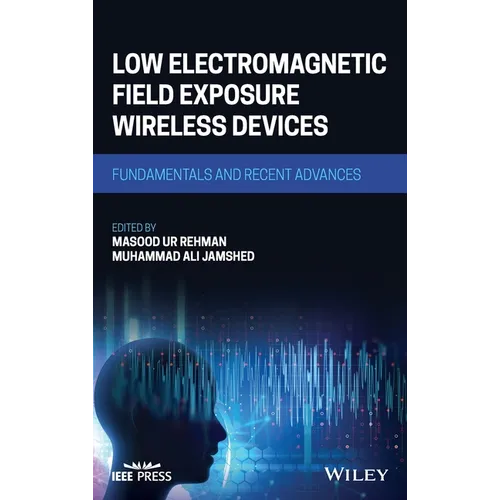
Product Description
by Masood Ur Rehman (Editor), Muhammad Ali Jamshed (Editor)
LOW ELECTROMAGNETIC FIELD EXPOSURE WIRELESS DEVICES
Comprehensive resource covering methods of designing energy efficient and low EMF wireless device techniques
Supported with real case studies and recent advancements and laying the foundation for future advancements in the field, Low Electromagnetic Field Exposure Wireless Devices: Fundamentals and Recent Advances describes both ways, i.e. hardware and software, in which the user-centric wireless communication devices can be designed to reduce the levels of EMF to limit the potential long-term effects of EMF on human health.
The text covers state-of-the-art and advanced topics such as EMF exposure standards and rationale, EMF evaluation tools, radio resource allocation, energy conservation, energy harvesting, EMF-aware antenna designs, and MIMO, and highlights advancements in this exciting field to date. To aid reader comprehension, the text contains numerous tables, illustrations, and photographs.
In Low Electromagnetic Field Exposure Wireless Devices: Fundamentals and Recent Advances, readers can expect to find information on:
- Fundamentals and key practices, and mechanisms and assessment methods, of exposure to electromagnetic fields
- The role of the smartphone on the assessment of exposure from 5G and antenna design considerations and techniques for low SAR mobile handsets
- Numerical exposure assessments of communication systems at higher frequencies and age-dependent exposure estimation using numerical methods
- Reinforcement learning and device-to-device communication in minimizing EMF exposure and emission-aware uplink resource allocation scheme for non-orthogonal multiple access systems
For wireless user equipment designers and hardware engineers, teachers in wireless communications, and postgraduate students in antennas for communication systems, Low Electromagnetic Field Exposure Wireless Devices: Fundamentals and Recent Advances is a must-have resource, covering an important topic that is expected to only grow in significance as future technological developments are made.
Back Jacket
Comprehensive resource covering methods of designing energy efficient and low EMF wireless device techniques
Supported with real case studies and recent advancements and laying the foundation for future advancements in the field, Low Electromagnetic Field Exposure Wireless Devices: Fundamentals and Recent Advances describes both ways, i.e. hardware and software, in which the user-centric wireless communication devices can be designed to reduce the levels of EMF to limit the potential long-term effects of EMF on human health.
The text covers state-of-the-art and advanced topics such as EMF exposure standards and rationale, EMF evaluation tools, radio resource allocation, energy conservation, energy harvesting, EMF-aware antenna designs, and MIMO, and highlights advancements in this exciting field to date. To aid reader comprehension, the text contains numerous tables, illustrations, and photographs.
In Low Electromagnetic Field Exposure Wireless Devices: Fundamentals and Recent Advances, readers can expect to find information on:
- Fundamentals and key practices, and mechanisms and assessment methods, of exposure to electromagnetic fields
- The role of the smartphone on the assessment of exposure from 5G and antenna design considerations and techniques for low SAR mobile handsets
- Numerical exposure assessments of communication systems at higher frequencies and age-dependent exposure estimation using numerical methods
- Reinforcement learning and device-to-device communication in minimizing EMF exposure and emission-aware uplink resource allocation scheme for non-orthogonal multiple access systems
For wireless user equipment designers and hardware engineers, teachers in wireless communications, and postgraduate students in antennas for communication systems, Low Electromagnetic Field Exposure Wireless Devices: Fundamentals and Recent Advances is a must-have resource, covering an important topic that is expected to only grow in significance as future technological developments are made.
Author Biography
Masood Ur Rehman is an Associate Professor in Electronic and Nanoscale Engineering at the University of Glasgow, UK. He is a Fellow of the Higher Education Academy UK and Senior Member of the IEEE and Associate Editor for IEEE Sensors Journal, IEEE Access, Microwave & Optical Technology Letters, and IET Electronics Letters.
Muhammad Ali Jamshed is a Research Assistant at the University of Glasgow, UK. Muhammad earned his PhD from the University of Surrey, Guildford, UK, in 2021. He is a Senior Member of the IEEE and Associate Editor of IET Network.