Product Description
by Charles River (Author)
*Includes pictures
*Includes a bibliography for further reading
"The employee is regarded by the employer merely in the light of his value as an operative. His productive capacity alone is taken into account." - Stanford
For many people, the Gilded Age and the dawn of the 20th century continue to be remembered for monopolies, trusts, and economic giants in heavy industries like railroads, oil, and steel. Men like Andrew Carnegie built empires like Carnegie Steel, and financiers like J.P. Morgan merged and consolidated them. The era also made names like Astor, Cooke, and Vanderbilt instantly recognizable across the globe. Over time, the unfathomable wealth generated by the businesses made the individuals on top incredibly rich, and that in turn led to immense criticism and an infamous epithet used to rail against them: robber barons.
The industrial might wielded by these executives in the late 19th century directly led to a public backlash and made President Teddy Roosevelt the "trust buster," and there has since been countless regulations to attempt to avoid the types of monopolies found over 100 years ago. However, many 20th century historians and writers pushed back against the allegations hurled at the "robber barons" and even took issue with the name. Libertarian writer John Stossel argued, "They weren't robbers, because they didn't steal from anyone, and they weren't barons-they were born poor..." Moreover, some of them set a precedent of sorts with their philanthropy.
The rise of the robber barons is typically associated with the East Coast and New York City, and when it comes to famous figures in the West during this time, most of them were outlaws, cowboys, lawmen, mountain men, and other types who helped push across the frontier. Those who explored the forested regions of the major mountain ranges and rode the plains of the central continent have always been the subjects of mystique and nostalgia, but while the West was being "won" by enormous cross-sections of the Civil War population moving toward the Pacific in search of a new life, the great cities and their attending technologies expanded in kind. Supporting the explorers and cowboys was a fraternity of iconic industrialists living in the rarified atmosphere of unbridled American wealth. Some of these tycoons funded expeditions and reaped rewards, while others sustained the cattle industry as the demand for beef in the North swelled in the wake of the Civil War. A few served as counterparts and middlemen to European and Asian enterprises, while some formed the backbone of expansion itself.
In tandem with that, a new tide of powerful American industrialists had their way, to the benefit and consternation of the general public, and while decrying the avarice of steel and railroad giants, well-to-do politicians, and titans of the banking system back in the East, the West received civic blessings as well. These included the first rail connection across the bulk of the continent, flourishing local economies in the major cities, and the niceties of the East Coast that included previously unthinkable universities.
One man among four major industrialists came to dominate the railroad extending from the west to Promontory, Utah more than any other. Whether he was the most capable is open to debate, but he made the essential investment at the most crucial moment. For this, he was given the keys to the entire industry in the West and sat atop Nob Hill as the financial king of San Francisco. In the process, he would become California's governor, and he would wind up lending his name to one of the country's most prestigious universities. That man was none other than a native New Yorker named Leland Stanford.
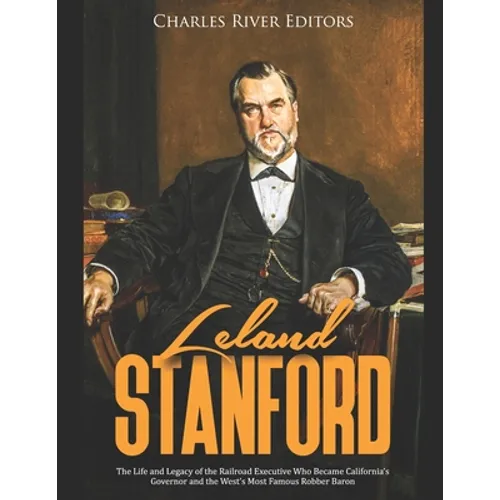
Leland Stanford: The Life and Legacy of the Railroad Executive Who Became California's Governor and the West's Most Famous Robber Baron chronicles the remarkable life of Stanford.