


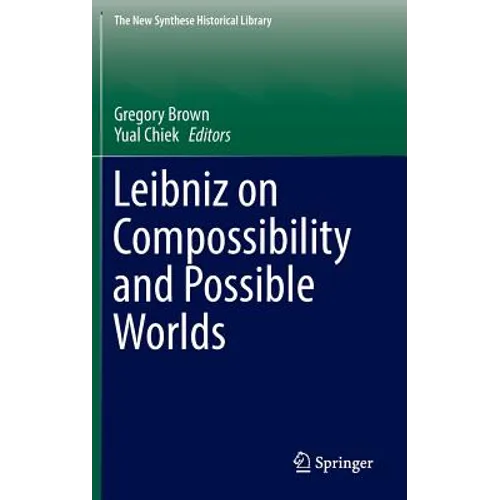
Product Description
by Gregory Brown (Editor), Yual Chiek (Editor)
This volume brings together a number of original articles by leading Leibniz scholars to address the meaning and significance of Leibniz's notions of compossibility and possible worlds. In order to avoid the conclusion that everything that exists is necessary, or that all possibles are actual, as Spinoza held, Leibniz argued that not all possible substances are compossible, that is, capable of coexisting. In Leibniz's view, the compossibility relation divides all possible substances into disjoint sets, each of which constitutes a possible world, or a way that God might have created things. For Leibniz, then, it is the compossibility relation that individuates possible worlds; and possible worlds form the objects of God's choice, from among which he chooses the best for creation. Thus the notions of compossibility and possible worlds are of major significance for Leibniz's metaphysics, his theodicy, and, ultimately, for his ethics.
Given the fact, however, that none of the approaches to understanding Leibniz's notions of compossibility and possible words suggested to date have gained universal acceptance, the goal of this book is to gather a body of new papers that explore ways of either refining previous interpretations in light of the objections that have been raised against them, or ways of framing new interpretations that will contribute to a fresh understanding of these key notions in Leibniz's thought.
Back Jacket
This volume brings together a number of original articles by leading Leibniz scholars to address the meaning and significance of Leibniz's notions of compossibility and possible worlds. In order to avoid the conclusion that everything that exists is necessary, or that all possibles are actual, as Spinoza held, Leibniz argued that not all possible substances are compossible, that is, capable of coexisting. In Leibniz's view, the compossibility relation divides all possible substances into disjoint sets, each of which constitutes a possible world, or a way that God might have created things. For Leibniz, then, it is the compossibility relation that individuates possible worlds; and possible worlds form the objects of God's choice, from among which he chooses the best for creation. Thus the notions of compossibility and possible worlds are of major significance for Leibniz's metaphysics, his theodicy, and, ultimately, for his ethics.
Given the fact, however, that none of the approaches to understanding Leibniz's notions of compossibility and possible words suggested to date have gained universal acceptance, the goal of this book is to gather a body of new papers that explore ways of either refining previous interpretations in light of the objections that have been raised against them, or ways of framing new interpretations that will contribute to a fresh understanding of these key notions in Leibniz's thought.
Author Biography
Yual Chiek is a PhD candidate at Queen's University, Kingston ON. He has presented his work at the Leibniz Society of North America, Yale University, Dartmouth College, and the Leibniz Universitat Hannover. He was a Visiting Research Assistant at Yale University, 2011-2013. His research interest include Early-Modern Philosophy, and Contemporary Epistemology and Metaphysics.
Gregory Brown is professor of Philosophy at The University of Houston, Texas. Brown has published numerous articles in the History of Philosophy and in the Philosophy of Leibniz. His papers have appeared in journals such as The Leibniz Society Review, The Journal of the History of Philosophy, and The British Journal for the History of Philosophy. His research interests are The History of Early-Modern Philosophy, and the History and Philosophy of Science.



