Product Description
by Lea Rawls (Author)
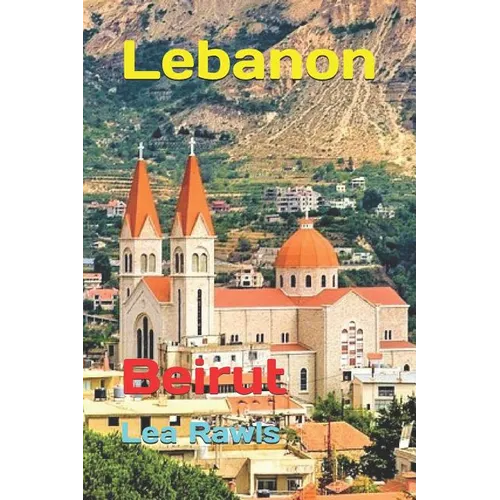
Lebanon is a country in Western Asia. It is bordered by Syria to the north and east and Israel to the south, while Cyprus is west across the Mediterranean Sea. Lebanon's location at the crossroads of the Mediterranean Basin and the Arabian hinterland facilitated its rich history and shaped a cultural identity of religious and ethnic diversity. At just 10,452 km2 (4,036 sq. mi.), it is the smallest recognized sovereign state on the mainland Asian continent. The earliest evidence of civilization in Lebanon dates back more than seven thousand years, predating recorded history. Lebanon was the home of the Canaanites/Phoenicians and their kingdoms, a maritime culture that flourished for over a thousand years (c. 1550-539 BC). In 64 BC, the region came under the rule of the Roman Empire, and eventually became one of the Empire's leading centers of Christianity. In the Mount Lebanon range a monastic tradition known as the Maronite Church was established. As the Arab Muslims conquered the region, the Maronites held onto their religion and identity. However, a new religious group, the Druze, established themselves in Mount Lebanon as well, generating a religious divide that has lasted for centuries. During the Crusades, the Maronites re-established contact with the Roman Catholic Church and asserted their communion with Rome. The ties they established with the Latins have influenced the region into the modern era.The region eventually was ruled by the Ottoman Empire from 1516 to 1918. Following the collapse of the empire after World War I, the five provinces that constitute modern Lebanon came under the French Mandate of Lebanon. The French expanded the borders of the Mount Lebanon Governorate, which was mostly populated by Maronites and Druze, to include more Muslims. Lebanon gained independence in 1943, establishing confessionalism, a unique, Consociationalism-type of political system with a power-sharing mechanism based on religious communities. Bechara El Khoury, President of Lebanon during the independence, Riad El-Solh, first Lebanese prime minister and Emir Majid Arslan II, first Lebanese minister of defence, are considered the founders of the modern Republic of Lebanon and are national heroes for having led the country's independence. Foreign troops withdrew completely from Lebanon on 31 December 1946. Lebanon has been a member of the United Nations since its founding in 1945 as well as of the Arab League (1945), the Non-Aligned Movement (1961), Organisation of the Islamic Cooperation (1969) and the Organisation internationale de la francophonie (1973).Despite its small size, the country has developed a well-known culture and has been highly influential in the Arab world, powered by its large diaspora. Before the Lebanese Civil War (1975-1990), the country experienced a period of relative calm and renowned prosperity, driven by tourism, agriculture, commerce, and banking. Because of its financial power and diversity in its heyday, Lebanon was referred to as the "Switzerland of the East" during the 1960s, and its capital, Beirut, attracted so many tourists that it was known as "the Paris of the Middle East." At the end of the war, there were extensive efforts to revive the economy and rebuild national infrastructure. In spite of these troubles, Lebanon has the 7th highest Human Development Index and GDP per capita in the Arab world after the oil-rich economies of the Persian Gulf.