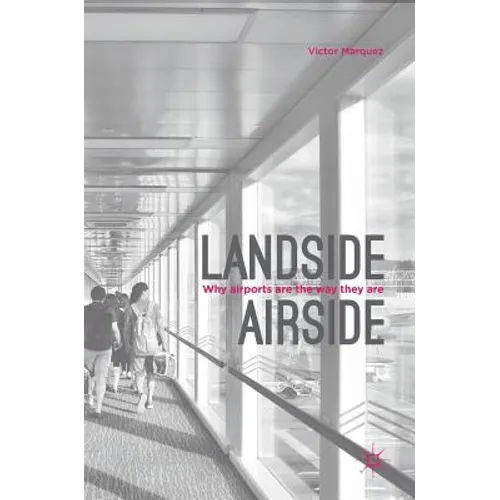
Product Description
by Victor Marquez (Author)
Introduction.- Chapter One: "The Romantic Borderline"- From Fences to the Skywalk: Landside-Airside Space in an Early American Airport: New York LaGuardia Terminal 1933-1939.- Chapter Two: "Reinventing the Airport?" Annex 14, Dulles Airport's "Mobile Lounge" and other Jet-Age paradigms: 1946-1962.- Chapter Three: "The Landside Airside Concept" Breaking to Reconnect: The "People Mover" at Tampa International Airport, 1962-1971.- Chapter Four: "Are Landside-Airside Boundaries Cultural Mirrors?" Reinventions, Innovations and Society.- Chapter Five: "The Liquid Airport" Security, Permeability, and Containment in Airports.- Conclusion.- Postscript.- Bibliography.
Back Jacket
Why do we love and hate airports at the same time? Have you been a victim of tiresome walks, congestion, long lines, invasive pat-downs, eternal delays and so on? Perhaps no other technological system has been challenged by continuously changing paradigms like airports. Think a minute on rail stations; think of how successful are the rail networks of the world in connecting nations, with just minimum security measures. Why aviation and airports are so radically different in this regard?
In order to answer those questions the author embarks on a thorough revision of airport history and airport planning that in the end builds up a new theory about how airports are formed from the outset. Within its journey from the early airfield to the newest hubs of today, Dr. Marquez identifies for the first time the Landside-Airside boundary as the single most important feature that shapes an airport. In this sense, his finding challenges the "historical linearity" that, until today, used to explain a century of airports.
From both an analytical and theoretical S&TS stance, Dr. Marquez assures that it is only when airports needed to be fully reinvented (LaGuardia, Dulles and Tampa) when they become transparent and we may be able to understand their lack of technological stability.
Author Biography
Dr. Victor Marquez is a researcher and designer with experience in more than ten airport master plans in the North American region. He earned his PhD and MA in Science and Technology Studies from Cornell University and his M Arch from University of Pennsylvania. He has been a Fulbright and Sage scholar, a Ted Talk lecturer, a contributor for The Futurist, an advisor of Discovery Channel and in 2016, finalist for the National Prize for Exact Sciences in Mexico.