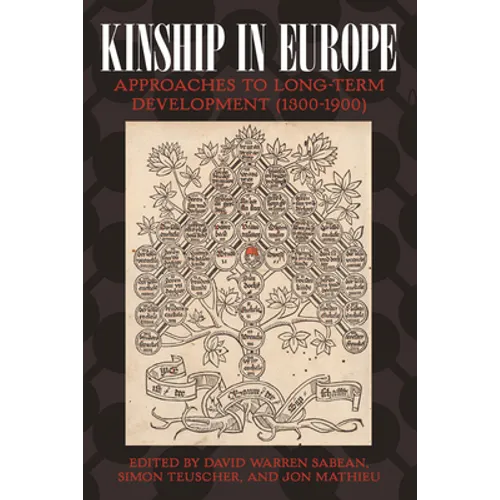
Product Description
by David Warren Sabean (Editor), Simon Teuscher (Editor), Jon Mathieu (Editor)
"On the whole, the general arguments made here for the continued importance of kinship in modernity, as well as the two major changes in kinship organization, are convincing. Kinship in Europe is also to be commended for its impressive array of subjects and the admirably diverse nature of its contributors. Above all, it manages to complicate traditional narratives of modernity, and provides a less simplistic, linear model of development." - H-German
Since the publication of Philippe Ariès's book, Centuries of Childhood, in the early 1960s, there has been great interest among historians in the history of the family and the household. A central aspect of the debate relates the story of the family to implicit notions of modernization, with the rise of the nuclear family in the West as part of its economic and political success. And some historians have pushed the idea of the nuclear family back in time for the most successful regions of Europe. During the past decade that synthesis has begun to break down as historians have begun to examine kinship, the way individual families are connected to each other through marriage and descent, finding that during the most dynamic period in European industrial development, class formation, and state reorganization, Europe became a "kinship hot" society. The essays in this volume explore two major transitions in kinship patterns--at the end of the Middle Ages and at the end of the eighteenth century--in an effort to reset the agenda in family history.
David Warren Sabean has taught at the University of East Anglia, University of Pittsburgh, Cornell University, and UCLA. He was a fellow of the Max Planck Institute for History (1976-83) and the Wissenschaftskolleg zu Berlin (2001-2). He is a Fellow of the American Academy of Arts and Sciences, and has been the recipient of an Alexander von Humboldt Foundation Forschungspreis (2004-6). He is currently the Henry J. Bruman Professor of German History at UCLA.
Simon Teuscher is Professor of History at the University of Basel. He has previously taught at UCLA (2000-2004) and Zurich (1995-99) and been a Resident Fellow at the Institute for Advanced Study in Princeton (2004-5).
Jon Mathieu has taught in different universities in Switzerland and in other countries. He was the founding director of the Istituto di Storia delle Alpi at the University of Lugano (2000-5), currently he is Professor at the University of Lucerne.