Product Description
by Shulamit S. Magnus (Author)
Solutions to divorce abuse in Jewish societies
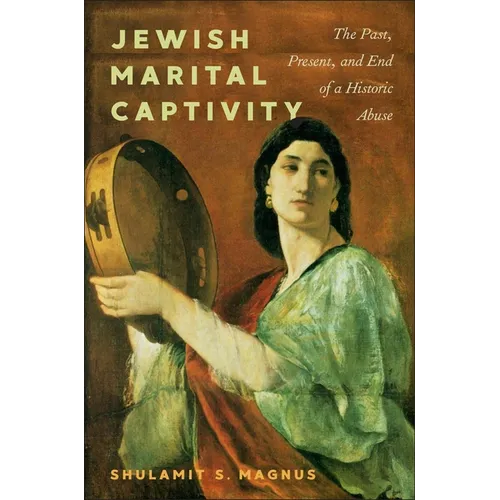
Jewish Marital Captivity centers on the experience of women encountering systemic disadvantage in rabbinic marriage and divorce throughout Jewish history and across the map of Jewish life. In rabbinic law, marriage is a unilateral act by the husband, making divorce, similarly, the husband's sole prerogative, in which his conscious will is also sacrosanct. Abuse necessarily follows, and has been the case from earliest recorded history when husbands abandoned wives, perished on business trips or in war or criminal incidents, or maliciously refused wives a rabbinic writ of divorce (get), or extorted for one, leaving wives trapped in marriage, including to dead men. There is no time limit to this state. Women in such marital captivity, without a husband's economic partnership, or divorce or death settlements, yet unfree to contract other marriages, suffered devastating social, economic, and psychological hardship, as did their children. Women's marital captivity has been treated as an issue in rabbinic law but has not, until now, been studied as a problem in Jewish societies across time and place, with a focus on the predicament and behavior of women. Jewish Marital Captivity is a social history of this problem from the seventh century to the present across multiple Jewish communities, focusing on the interaction of law and social reality. Magnus documents a pattern of assertive and transgressive actions by pious and rebellious women in traditional Jewish societies to escape marital captivity, often, with the assistance of male kin, also probing why such behavior emerged in pre-modern, patriarchal societies. She charts women's role in the emergence of reforms in the medieval era offering women significant protections in marriage and divorce, and rabbinic backlash against these advances. This backlash was codified and its legal rulings are enacted to this day in rabbinic courts in the US and other Diaspora communities and in Israel, which lacks civil marriage and divorce and where Jewish citizens can only get divorced in rabbinic courts. It combines a sweeping history of Jewish women's marital captivity with an analysis of the problem's systemic nature, however personally and individually women experience it, and with a critique of current policy as seeking to manage and thus, perpetuate, rather than end the abuse. It applies the lessons of the history uncovered to propose solutions to what Magnus presents not as an Orthodox or an Israeli problem, but a Jewish one.
Number of Pages: 376
Dimensions: 1.3 x 9 x 5.9 IN
Publication Date: August 19, 2025