


Product Description
by Drew Gilpin Faust (Author)
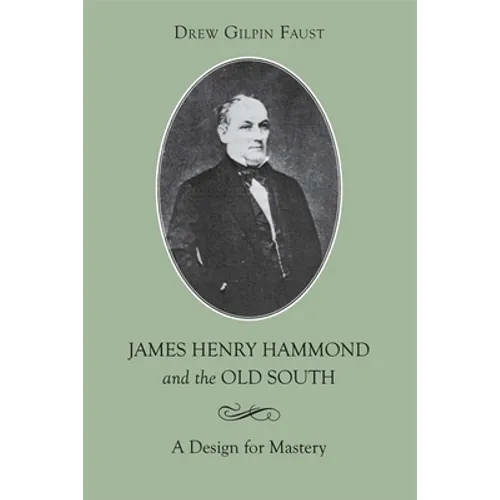
From his birth in 1807 to his death in 1864 as Sherman's troops marched in triumph toward South Carolina, James Henry Hammond witnessed the rise and fall of the cotton kingdom of the Old South. Planter, politician, and an ardent defender of slavery and white supremacy, Hammond built a career for himself that in its breadth and ambition provides a composite portrait of the civilization in which he flourished.
A long-awaited biography, Drew Gilpin Faust's James Henry Hammond and the Old South reveals the South Carolina planter who was at once characteristic of his age and unique among men of his time. Of humble origins, Hammond set out to conquer his society, to make himself a leader and a spokesman for the Old South. Through marriage he acquired a large plantation and many slaves, and then through their coerced labor, shrewd management practices, and progressive farming techniques, he soon became one of the wealthiest men in South Carolina. He was elected to the United States House of Representatives and served as governor of his state. Evidence that he sexually abused four of his teenage nieces forced him to retreat for many years to his plantation, but eventually he returned to public view, winning a seat in the United States Senate that he resigned when South Carolina seceded from the Union.
James Henry Hammond's ambition was unquenchable. It consumed his life, directed almost his every move and ultimately, in its titanic calculation and rigidity, destroyed the man confined within it. Like Faulkner's Thomas Sutpen, Faust suggests, Hammond had a "design," a compulsion to direct every moment of his life toward self-aggrandizement and legitimation. Despite his sexual abuse of enslaved females and their children, like other plantation owners, Hammond envisioned himself as benevolent and paternal. He saw himself as the absolute master of his family and slaves, but neither his family, his slaves, nor even his own behavior was completely under his command. Hammond fervently wished to perfect and preserve what he envisioned as the southern way of life. But these goals were also beyond his control. At the time of his death it had become clear to him that his world, the world of the Old South, had ended.
Author Biography
Drew Gilpin Faust is associate professor and chairman of the Department of American Civilization, University of Pennsylvania. She is the author of A Sacred Circle: The Dilemma of the Intellectual in the Old South, 1840--1860 and the editor of The Ideology of Slavery: Proslavery Thought in the Antebellum South 1830--1860.



