


Product Description
by James Harvey (Author)
In Jacques Rancière and the Politics of Art Cinema, James Harvey contends that Rancière's writing allows us to broach art and politics on the very same terms: each involves the visible and the invisible, the heard and unheard, and the distribution of bodies in a perceivable social order. Between making, performing, viewing and sharing films, a space is constructed for tracing and realigning the margins of society, allowing us to consider the potential of cinema to create new political subjects. Drawing on case studies of films including Charlie Kaufman's Synecdoche, New York, Nuri Bilge Ceylan's Climates and John Akomfrah's The Nine Muses, this books asks to what extent is politics shaping art cinema? And, in turn, could art cinema possibly affect the political structure of the world as we know it?
Front Jacket
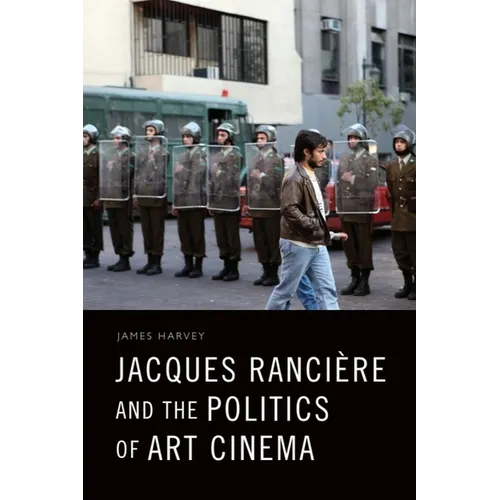
'James Harvey is to be congratulated for fine and careful work that will stand strong and true both in film studies and, more generally, in Rancière's critical reception.' Tom Conley, Harvard University James Harvey contends that Rancière's writing allows us to broach art and politics on the very same terms: each involves the visible and the invisible, the heard and unheard, and the distribution of bodies in a perceivable social order. Between making, performing, viewing and sharing films, a space is constructed for tracing and realigning the margins of society, allowing us to consider the potential of cinema to create new political subjects. Drawing on case studies of films including Charlie Kaufman's Synecdoche, New York, Nuri Bilge Ceylan's Climates and John Akomfrah's The Nine Muses, this books asks to what extent is politics shaping art cinema. And - in turn - could art cinema possibly affect the political structure of the world as we know it? James Harvey is an Associate Lecturer in Film Studies at Anglia Ruskin University. Cover image: No, Pablo Larrain, 2012 (c) Sony Picture Classics/Photofest Cover design: [EUP logo] edinburghuniversitypress.com ISBN 978-1-4744-2378-6 Barcode
Author Biography
James Harvey is an independent scholar. His research interests revolve around contemporary global politics, continental philosophy, film and visual culture. He is also the editor of Nationalism in Contemporary Western European Cinema (Palgrave Macmillan, 2018).



