


Product Description
by Pellegrino Artusi (Author), Olga Ragusa (Author)
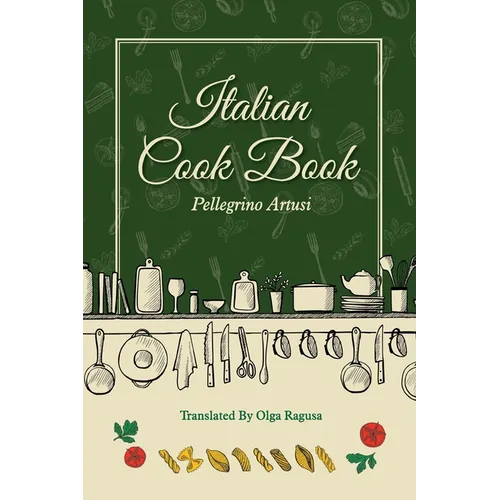
Pellegrino Artusi's Italian Cook Book is a collection of Italian recipes first published in 1891. This version was edited and translated by New York-based academic Olga Ragusa in 1945. It contains nearly 400 recipes that highlight the art of traditional Italian cooking at a time when French cuisine had long dominated the kitchens and plates of gourmands.
Pellegrino Artusi (1820-1911) was an unlikely person to revitalize Italian cuisine, being neither a professional chef nor a formal culinary scholar. Artusi was born in Forlimpopoli to a wealthy merchant father, and he successfully took over the family's business as a young man. His life-and that of his family-was violently disrupted in 1851, when the criminal Stefano Pelloni arrived in town. He and his gang disrupted a play and held all the wealthy families hostage in the theater while they robbed and sacked the town. One of Artusi's sisters was assaulted during the raid and the ensuing shock placed her in an asylum. (Pelloni was killed just two months later in a gunfight.)
After the trauma, Artusi and his family moved to Florence, where he began working as a silk merchant and later in finance. During his free time, he devoted himself to the art of Italian cooking. French cooking had been considered the "gold standard" in culinary circles for centuries, but Artusi rejected the notion that French food was superior to his native Italian. He devoted himself to learning more about the cuisine of his ancestors.
By 1891, at the age of 71, Artusi had completed what is considered the original Italian cookbook. He had compiled and edited recipes from much of the newly unified Italy, creating for the first time a broader manual to the nation's various culinary styles. Still, the book's recipes lean toward the northern culinary styles of Romagna and Tuscany.
Unable to find a publisher, he funded and self-published the work. It was a modest success at first, selling a thousand copies in four years. But word spread, and before his death in 1911, the book had sold over 200,000 copies.
This version was edited and translated by the New York-based linguist, scholar, and academic Olga Ragusa. It was published in 1945 by the S.F. Vanni publishing house, then owned by her father.
Containing nearly 400 recipes, the instructions in the Italian Cook Book are simple to follow and can be easily recreated in the modern kitchen-with some exceptions. Sourcing the two dozen large frogs for Frog Soup may prove a challenge. But the recipes for handmade pasta, gnocchi, and ravioli in the Romagna and Genoese styles are simple and approachable.
Crostinis, slices of toast piled with savory toppings, make delicious appetizers when topped with anchovies, caviar, or chicken liver. Italian-style sauces are abundant, including caper sauce for drizzling over boiled fish, meatless sauce for spaghetti, and "the sauce of the Pope"-a briny sauce from the caper vinegar, sweetened olives, chopped onions, butter, and an anchovy.
The home cook will find some meats that are easy to source-chicken, lamb, turkey, beef, pork, and plenty of fish. Others will prove more difficult to find, like partridge, blackbird, wild boar, and thrush. Some of the less common organ meats are also used, including tongue, kidneys, and liver.
Italian home cooks will want to linger in the dessert section, full of simple cakes, pies, and puddings, as well as rustic fruit dishes like pears in syrup and peaches stuffed with candied orange peel and nuts.
Artusi is considered by many to be the father of modern Italian cuisine. Since 1997, he has been celebrated each year in his birthplace of Forlimpopoli with Festa Atrusiana, an Italian food festival.