


Product Description
by U. S. Chemical Safe Investigation Board (Author)
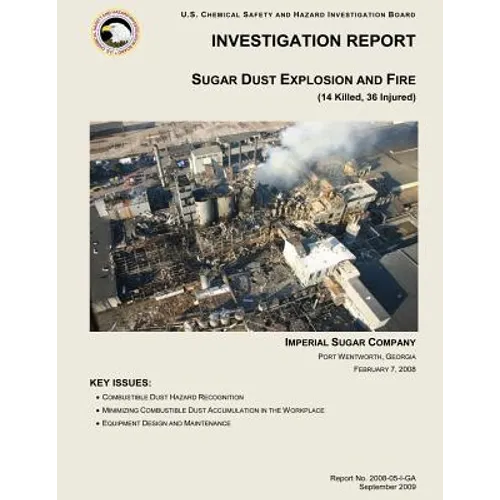
On February 7, 2008, at about 7:15 p.m., a series of sugar dust explosions at the Imperial Sugar manufacturing facility in Port Wentworth, Georgia, resulted in 14 worker fatalities. Eight workers died at the scene and six others eventually succumbed to their injuries at the Joseph M. Still Burn Center in Augusta, Georgia. Thirty six workers were treated for serious burns and injuries-some caused permanent, life altering conditions. The explosions and subsequent fires destroyed the sugar packing buildings, palletizer room, and silos, and severely damaged the bulk train car loading area and parts of the sugar refining process areas. The Imperial Sugar manufacturing facility housed a refinery that converts raw cane sugar into granulated sugar. A system of screw and belt conveyors, and bucket elevators transported granulated sugar from the refinery to three 105-foot tall sugar storage silos. It was then transported through conveyors and bucket elevators to specialty sugar processing areas and granulated sugar packaging machines. Sugar products were packaged in four-story packing buildings that surrounded the silos, or loaded into railcars and tanker trucks in the bulk sugar loading area. The U.S. Chemical Safety and Hazard Investigation Board (CSB) determined that the first dust explosion initiated in the enclosed steel belt conveyor located below the sugar silos. The recently installed steel cover panels on the belt conveyor allowed explosive concentrations of sugar dust to accumulate inside the enclosure. An unknown source ignited the sugar dust, causing a violent explosion. The explosion lofted sugar dust that had accumulated on the floors and elevated horizontal surfaces, propagating more dust explosions through the buildings. Secondary dust explosions occurred throughout the packing buildings, parts of the refinery, and the bulk sugar loading buildings. The pressure waves from the explosions heaved thick concrete floors and collapsed brick walls, blocking stairwell and other exit routes. The resulting fires destroyed the packing buildings, silos, palletizer building and heavily damaged parts of the refinery and bulk sugar loading area.



