


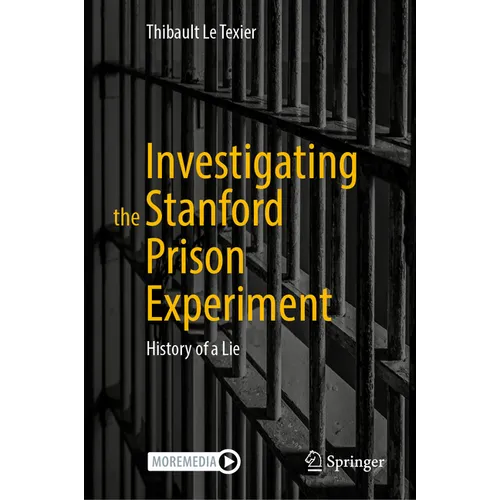
Product Description
by Thibault Le Texier (Author)
In 1971, psychologist Philip Zimbardo ran the now famous Stanford prison experiment to show that prison could make normal people behave in pathological ways.
Based on the first thorough investigation in the archives of the experiment and on interviews with about half of its participants, this book shows that the Stanford prison experiment is far from being scientific. In particular, the guards knew what results were expected from them, they were trained and supervised by the experimenters, and they were following a schedule and a set of rules written by the experimenters. The experimenters deceived the guards and made them believe they were not subjects. They also borrowed many elements from a previous student experiment without disclosing this information in their reports. The prisoners were not allowed to leave the experiment at will, and they were conditioned by the experimenters. The mock prison situation was unrealistic. Most participants did not forget they were participating in an experiment, and many responded to demand characteristics. The data was not collected properly. And the conclusions were pre-written according to non-academic aims.
This book goes beyond the experiment to provide ample background and context, in order to understand how the experiment was planned, financed, recorded, and divulged in the press and within the academic. It discusses also the role played by Philip Zimbardo in the trial of one of the guards of Abu Ghraib, as well as the impact of mass media on science, the debates between personal psychology and social psychology, and the specific nature of cold war social science.
Back Jacket
In 1971, psychologist Philip Zimbardo ran the now famous Stanford prison experiment to show that prison could make normal people behave in pathological ways. Based on the first thorough investigation in the archives of the experiment and on interviews with about half of its participants, this book shows that the Stanford prison experiment is far from being scientific. In particular, the guards knew what results were expected from them, they were trained and supervised by the experimenters, and they were following a schedule and a set of rules written by the experimenters. The experimenters deceived the guards and made them believe they were not subjects. They also borrowed many elements from a previous student experiment without disclosing this information in their reports. The prisoners were not allowed to leave the experiment at will, and they were conditioned by the experimenters. The mock prison situation was unrealistic. Most participants did not forget they were participating in an experiment, and many responded to demand characteristics. The data was not collected properly. And the conclusions were pre-written according to non-academic aims.
This book goes beyond the experiment to provide ample background and context, in order to understand how the experiment was planned, financed, recorded, and divulged in the press and within the academic. It discusses also the role played by Philip Zimbardo in the trial of one of the guards of Abu Ghraib, as well as the impact of mass media on science, the debates between personal psychology and social psychology, and the specific nature of cold war social science.
Author Biography
Thibault Le Texier is associate researcher at the Sorbonne University. He is a specialist of the epistemology of social sciences and the author of three books.



