


Product Description
by Gianpaolo Ghiani (Author), Gilbert Laporte (Author), Roberto Musmanno (Author)
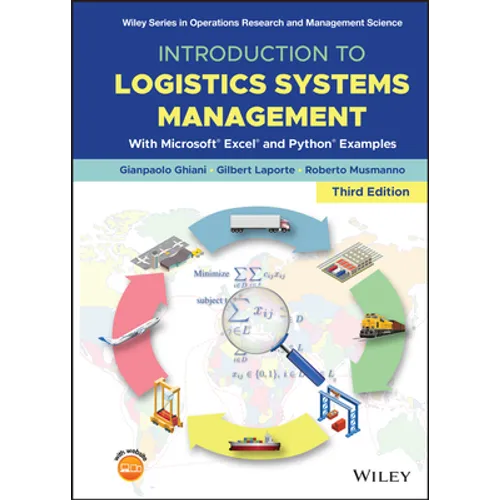
INTRODUCTION TO LOGISTICS SYSTEMS MANAGEMENT
The updated new edition of the award-winning introductory textbook on logistics system management
Introduction to Logistics Systems Management provides an in-depth introduction to the methodological aspects of planning, organization, and control of logistics for organizations in the private, public and non-profit sectors. Based on the authors' extensive teaching, research, and industrial consulting experience, this classic textbook is used in universities worldwide to teach students the use of quantitative methods for solving complex logistics problems.
Fully updated and revised, the third edition places increased emphasis on the complexity and flexibility required by modern logistics systems. In this context, the extensive use of data, descriptive analytics, predictive models, and optimization techniques will be invaluable to support the decisions and actions of logistics and supply chain managers. Throughout the book, brand-new case studies and numerical examples illustrate how various methods can be used in industrial and service logistics to reduce costs and improve service levels. The book:
- includes new models and techniques that have emerged over the past decade;
- describes methodologies for logistics decision making, forecasting, logistics system design, procurement, warehouse management, and freight transportation management;
- includes end-of-chapter exercises, Microsoft(R) Excel(R) files and Python(R) computer codes for each algorithm covered;
- includes access to a companion website with additional exercises, links to video tutorials, and supplementary teaching material.
To facilitate creation of course material, additional LaTeX source data containing the formulae, optimization models, tables and algorithms described in the book is available to instructors.
Introduction to Logistics Systems Management, Third Edition remains an essential textbook for senior undergraduate and graduate students in engineering, computer science, and management science courses. It is also a highly useful reference for academic researchers and industry practitioners alike.
Back Jacket
The updated new edition of the award-winning introductory textbook on logistics system management
Introduction to Logistics Systems Management provides an in-depth introduction to the methodological aspects of planning, organization, and control of logistics for organizations in the private, public and non-profit sectors. Based on the authors' extensive teaching, research, and industrial consulting experience, this classic textbook is used in universities worldwide to teach students the use of quantitative methods for solving complex logistics problems.
Fully updated and revised, the third edition places increased emphasis on the complexity and flexibility required by modern logistics systems. In this context, the extensive use of data, descriptive analytics, predictive models, and optimization techniques will be invaluable to support the decisions and actions of logistics and supply chain managers. Throughout the book, brand-new case studies and numerical examples illustrate how various methods can be used in industrial and service logistics to reduce costs and improve service levels. The book:
- includes new models and techniques that have emerged over the past decade;
- describes methodologies for logistics decision making, forecasting, logistics system design, procurement, warehouse management, and freight transportation management;
- includes end-of-chapter exercises, Microsoft(R) Excel(R) files and Python(R) computer codes for each algorithm covered;
- includes access to a companion website with additional exercises, links to video tutorials, and supplementary teaching material.
To facilitate creation of course material, additional LaTeX source data containing the formulae, optimization models, tables and algorithms described in the book is available to instructors.
Introduction to Logistics Systems Management, Third Edition remains an essential textbook for senior undergraduate and graduate students in engineering, computer science, and management science courses. It is also a highly useful reference for academic researchers and industry practitioners alike.
Author Biography
Gianpaolo Ghiani, Professor of Operations Research, University of Salento, Lecce, Italy.
Gilbert Laporte, Professor Emeritus, Department of Decision Sciences, HEC, Montréal, Canada and University of Bath, United Kingdom.
Roberto Musmanno, Professor of Operations Research, University of Calabria, Italy.