Product Description
by James W. Dally (Author), Eric L. Wang (Author), Jeffery C. Lacombe (Author)
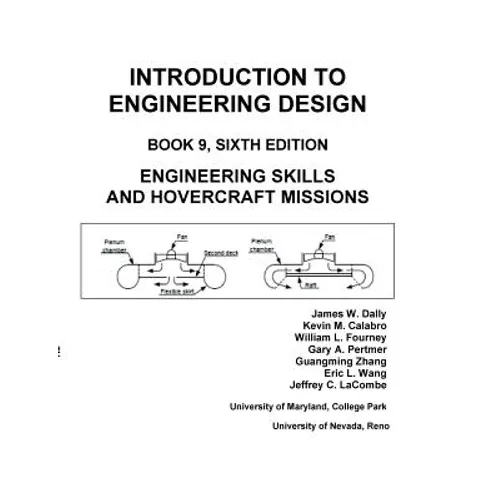
This book is the sixth edition of the ninth textbook in this series dealing with Introduction to Engineering
Design. Jim Dally, working with College House Enterprises, has prepared eight previous books in this
series--a new one almost every academic year--for the first-year engineering students of the University of
Maryland at College Park. Several other Colleges of Engineering have adopted one or more of the books in
this series to introduce design and engineering skills for their first or second year students.
The book is organized into parts to present many topics that first year engineering students should
understand as they proceed through a significant portion of the product realization process. Product and
system development processes are introduced in Part I. Information on team skills and the importance of the
product development process is covered in Chapter 1 and 2. The hovercraft missions are also presented in
Chapter 2 together with a description of the design concepts involved in hovercraft development. By
assigning a demanding project, a holistic approach is employed in the student's first engineering experience
that motivates them. Design of a hovercraft enables the instructor an opportunity to integrate a spectrum of
knowledge about many topics. The student's hands-on participation in design, building and testing a
hovercraft significantly enhances their learning process. The theoretical background needed to conduct design
analyses for the hovercraft is presented in Chapter 3. Chapter 4 describes basic electric circuits to provide
technical background helpful for the design of the hovercraft. Sensors used to provide feedback signals for
control of the hovercraft are discussed in Chapter 5. Chapter 6 introduces the fuel cells that will be used or propulsion of the hovercrafts, and finally, an extensive and detailed description of programming in LabVIEW
is included in Chapter 7.
Part II treats the very important topic of communications in engineering. This starts with a relatively
complete treatment of three-view drawings in Chapter 8 and an introduction to pictorial drawings (including
isometric, oblique, and perspective drawings) in provided in Chapter 9. The use of tables and graphs in
communicating engineering information using Microsoft Excel is presented in Chapter 10. Finally, Chapter
11 focuses on technical reports and describes many aspects of technical writing and library research.
Part III introduces the students to engineering as a profession. A historical perspective on the
role engineering played in developing civilization and on improving the lives of the masses is presented in
Chapter 15 where we move from the past into the present and indicate the current relationships between
business, consumers and society. Chapter 16 discusses the balance among safety, risk and performance. It
includes a listing of hazards, which is important in identifying the many different ways users of a product can
be harmed. Chapter 17 on ethics, character and engineering includes a large number of topics so the instructor
can select from among them.