


Product Description
by Thomas Mailund (Author)
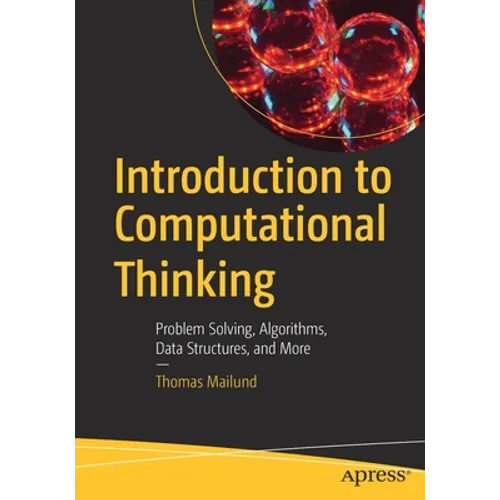
Learn approaches of computational thinking and the art of designing algorithms. Most of the algorithms you will see in this book are used in almost all software that runs on your computer.
Learning how to program can be very rewarding. It is a special feeling to seeing a computer translate your thoughts into actions and see it solve your problems for you. To get to that point, however, you must learn to think about computations in a new way--you must learn computational thinking.
This book begins by discussing models of the world and how to formalize problems. This leads onto a definition of computational thinking and putting computational thinking in a broader context. The practical coding in the book is carried out in Python; you'll get an introduction to Python programming, including how to set up your development environment.What You Will Learn
- Think in a computational way
- Acquire general techniques for problem solving
- See general and concrete algorithmic techniques
- Program solutions that are both computationally efficient and maintainable
Who This Book Is For
Those new to programming and computer science who are interested in learning how to program algorithms and working with other computational aspects of programming.
Back Jacket
Learn approaches of computational thinking and the art of designing algorithms. Most of the algorithms you will see in this book are used in almost all software that runs on your computer.
Learning how to program can be very rewarding. It is a special feeling to seeing a computer translate your thoughts into actions and see it solve your problems for you. To get to that point, however, you must learn to think about computations in a new way--you must learn computational thinking.
This book begins by discussing models of the world and how to formalize problems. This leads onto a definition of computational thinking and putting computational thinking in a broader context. The practical coding in the book is carried out in Python; you'll get an introduction to Python programming, including how to set up your development environment.
You will:
- Think in a computational way
- Acquire general techniques for problem solving
- See general and concrete algorithmic techniques
- Program solutions that are both computationally efficient and maintainable
Author Biography
Thomas Mailund, PhD is an associate professor in bioinformatics at Aarhus University, Denmark. He has a background in math and computer science, including experience programming and teaching in the C, Python and R programming languages. For the last decade, his main focus has been on genetics and evolutionary studies, particularly comparative genomics, speciation, and gene flow between emerging species.