Product Description
by Jeong-Yeol Yoon (Author)
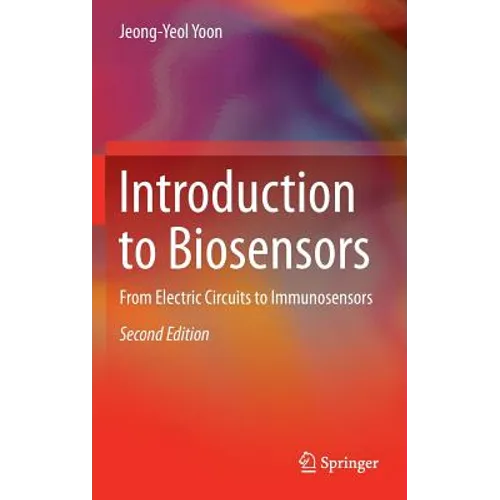
This book equips students with a thorough understanding of various types of sensors and biosensors that can be used for chemical, biological, and biomedical applications, including but not limited to temperature sensors, strain sensor, light sensors, spectrophotometric sensors, pulse oximeter, optical fiber probes, fluorescence sensors, pH sensor, ion-selective electrodes, piezoelectric sensors, glucose sensors, DNA and immunosensors, lab-on-a-chip biosensors, paper-based lab-on-a-chip biosensors, and microcontroller-based sensors. The author treats the study of biosensors with an applications-based approach, including over 15 extensive, hands-on labs given at the end of each chapter. The material is presented using a building-block approach, beginning with the fundamentals of sensor design and temperature sensors, and ending with more complicated biosensors.New to this second edition are sections on op-amp filters, pulse oximetry, meat quality monitoring, advanced fluorescent dyes, autofluorescence, various fluorescence detection methods, fluoride ion-selective electrode, advanced glucose sensing methods including continuous glucose monitoring, paper-based lab-on-a-chip, etc. A new chapter on nano-biosensors and an appendix on microcontrollers make this textbook ideal for undergraduate engineering students studying biosensors. It can also serve as a hands-on guide for scientists and engineers working in the sensor or biosensor industries.
Back Jacket
This book equips students with a thorough understanding of various types of sensors and biosensors that can be used for chemical, biological, and biomedical applications, including but not limited to temperature sensors, strain sensor, light sensors, spectrophotometric sensors, pulse oximeter, optical fiber probes, fluorescence sensors, pH sensor, ion-selective electrodes, piezoelectric sensors, glucose sensors, DNA and immunosensors, lab-on-a-chip biosensors, paper-based lab-on-a-chip biosensors, and microcontroller-based sensors. The author treats the study of biosensors with an applications-based approach, including over 15 extensive, hands-on labs given at the end of each chapter. The material is presented using a building-block approach, beginning with the fundamentals of sensor design and temperature sensors, and ending with more complicated biosensors.New to this second edition are sections on op-amp filters, pulse oximetry, meat quality monitoring, advanced fluorescent dyes, autofluorescence, various fluorescence detection methods, fluoride ion-selective electrode, advanced glucose sensing methods including continuous glucose monitoring, paper-based lab-on-a-chip, etc. A new chapter on nano-biosensors and an appendix on microcontrollers make this textbook ideal for undergraduate engineering students studying biosensors. It can also serve as a hands-on guide for scientists and engineers working in the sensor or biosensor industries.
Author Biography
Jeong-Yeol Yoon received his B.S., M.S., and Ph.D. degrees in Chemical Engineering from Yonsei University, Seoul (South Korea) in 1992, 1994, and 1999 respectively, under the guidance of Dr. Woo-Sik Kim, in collaboration with Dr. Jung-Hyun Kim, where he worked primarily on polymer colloids. He received his second Ph.D. in Biomedical Engineering from the University of California, Los Angeles (UCLA) in 2004, working on lab-on-a-chip and biomaterials, under the guidance of Dr. Robin L. Garrell. He joined the Agricultural & Biosystems Engineering faculty in August 2004 and holds joint appointment in the Department of Biomedical Engineering and BIO5 Institute at the University of Arizona. Dr. Yoon is currently Professor and is directing the Biosensors Lab (http: //biosensors.abe.arizona.edu). He is a member of the Institute of Biological Engineering (IBE), American Society of Agricultural and Biological Engineers (ASABE), and SPIE--The International Society for Optics and Photonics. He was an elected president of IBE (http: //www.ibe.org) for the 2015 calendar year. Dr. Yoon currently serves as one of two Editor-in-Chief's for Journal of Biological Engineering (http: //www.jbioleng.org), the official journal of IBE, published by BioMed Central. He also serves (or had served) as Associate Editor and Editorial Board Members for numerous journals, including Scientific Reports, Journal of Biological Engineering, Biological Engineering Transactions, and Transactions of the ASABE.