Product Description
by Anders Wivel (Editor), T. V. Paul (Editor)
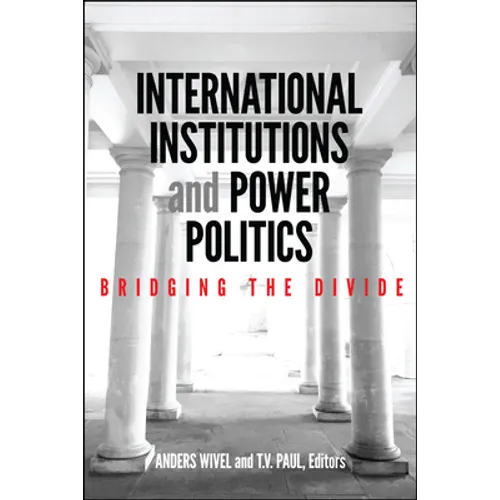
This book moves scholarly debates beyond the old question of whether or not international institutions matter in order to examine how they matter, even in a world of power politics. Power politics and international institutions are often studied as two separate domains, but this is in need of rethinking because today most states strategically use institutions to further their interests. Anders Wivel, T.V. Paul, and the international group of contributing authors update our understanding of how institutions are viewed among the major theoretical paradigms in international relations, and they seek to bridge the divides. Empirical chapters examine specific institutions in practice, including the United Nations, International Atomic Energy Agency, and the European Union. The book also points the way to future research. International Institutions and Power Politics provides insights for both international relations theory and practical matters of foreign affairs, and it will be essential reading for all international relations scholars and advanced students.
Front Jacket
International Relations
"This volume engages in an urgently needed effort to bridge the divide between realism and institutionalism. Re-reading, expanding, and re-conceptualizing realist conceptions of power, the contributions challenge our preconceptions about state power and international organizations. Thus, they make an important contribution towards a renewed inter-paradigmatic dialogue in international relations."
--Thomas Diez, professor of political science and international relations, Eberhard Karls University of Tübingen
This book moves scholarly debates beyond the old question of whether international institutions matter in order to examine how they matter, even in a world of power politics. Power politics and international institutions are often studied as two separate domains, but today most states strategically use institutions to further their interests. Anders Wivel, T.V. Paul, and the international group of contributing authors update our understanding of how institutions are viewed among the major theoretical paradigms in international relations. Empirical chapters examine specific institutions in practice, including the United Nations, International Atomic Energy Agency, and the European Union.
International Institutions and Power Politics provides insights for both international relations theory and practical matters of foreign affairs, and it will be essential reading for all international relations scholars and advanced students.
Anders Wivel is a professor in the Department of Political Science at University of Copenhagen. He is author, co-author or editor of eleven books including Security Strategies and American World Order: Lost Power and Explaining Foreign Policy: International Diplomacy and the Russo-Georgian War.T.V. Paul is the James McGill Professor of International Relations at McGill University; former president of the International Studies Association; and author, coauthor, or editor of twenty books including Restraining Great Powers: Soft Balancing from Empires to the Global Era and The China-India Rivalry in the Globalization Era.
Contributors: Anders Wivel, T.V. Paul, J. Samuel Barkin, Austin Carson, Annette Freyberg-Inan, Stacie Goddard, John A. Hall, Steven E. Lobell, Sarah-Myriam Martin-Brûlé, Frédéric Mérand, Daniel H. Nexon, Brad Nicholson, Lou Pingeot, Vincent Pouliot, Norrin M. Ripsman, Ben Rosamond, Georg Sørensen, Alexander Thompson, Patricia A. Weitsman
Back Jacket
International Relations
"This volume engages in an urgently needed effort to bridge the divide between realism and institutionalism. Re-reading, expanding, and re-conceptualizing realist conceptions of power, the contributions challenge our preconceptions about state power and international organizations. Thus, they make an important contribution towards a renewed inter-paradigmatic dialogue in international relations."
--Thomas Diez, professor of political science and international relations, Eberhard Karls University of Tübingen
This book moves scholarly debates beyond the old question of whether international institutions matter in order to examine how they matter, even in a world of power politics. Power politics and international institutions are often studied as two separate domains, but today most states strategically use institutions to further their interests. Anders Wivel, T.V. Paul, and the international group of contributing authors update our understanding of how institutions are viewed among the major theoretical paradigms in international relations. Empirical chapters examine specific institutions in practice, including the United Nations, International Atomic Energy Agency, and the European Union.
International Institutions and Power Politics provides insights for both international relations theory and practical matters of foreign affairs, and it will be essential reading for all international relations scholars and advanced students.
Anders Wivel is a professor in the Department of Political Science at University of Copenhagen. He is author, co-author or editor of eleven books including Security Strategies and American World Order: Lost Power and Explaining Foreign Policy: International Diplomacy and the Russo-Georgian War.T.V. Paul is the James McGill Professor of International Relations at McGill University; former president of the International Studies Association; and author, coauthor, or editor of twenty books including Restraining Great Powers: Soft Balancing from Empires to the Global Era and The China-India Rivalry in the Globalization Era.
Contributors: Anders Wivel, T.V. Paul, J. Samuel Barkin, Austin Carson, Annette Freyberg-Inan, Stacie Goddard, John A. Hall, Steven E. Lobell, Sarah-Myriam Martin-Brûlé, Frédéric Mérand, Daniel H. Nexon, Brad Nicholson, Lou Pingeot, Vincent Pouliot, Norrin M. Ripsman, Ben Rosamond, Georg Sørensen, Alexander Thompson, Patricia A. Weitsman
Author Biography
Anders Wivel is a professor in the Department of Political Science at University of Copenhagen. He is author, co-author or editor of eleven books including Security Strategies and American World Order: Lost Power and Explaining Foreign Policy: International Diplomacy and the Russo-Georgian War.
T.V. Paul is the James McGill Professor of International Relations at McGill University; former president of the International Studies Association; and author, co-author, or editor of twenty books including Restraining Great Powers: Soft Balancing from Empires to the Global Era and The China-India Rivalry in the Globalization Era.