


Product Description
by Norman Friedman (Author), Mark D. Mandeles (Author), Naval War College Press (Author)
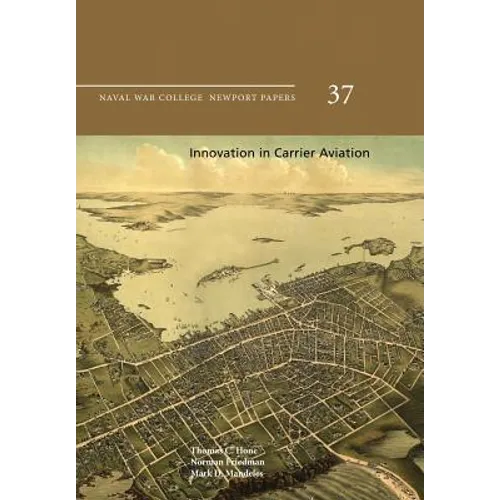
In a widely noted speech to the Navy League Sea-Air-Space Expo in May 2010, Secretary of Defense Robert M. Gates warned that "the Navy and Marine Corps must be willing to reexamine and question basic assumptions in light of evolving technologies, new threats, and budget realities.We simply cannot afford to perpetuate a status quo that heaps more and more expensive technologies onto fewer and fewer platforms-thereby risking a situation where some of our greatest capital expenditures go toward weapons and ships that could potentially become wasting assets." Secretary Gates specifically questioned whether the Navy's commitment to a force of eleven carrier strike groups through 2040 makes sense, given the extent of the anticipated superiority of the United States over potential adversaries at sea as well as the growing threat of antiship missiles. Though later disclaiming any immediate intention to seek a reduction in the current carrier force, Gates nevertheless laid down a clear marker that all who are concerned over the future of the U.S. Navy would be well advised to take with the utmost seriousness. We may stand, then, at an important watershed in the evolution of carrier aviation, one reflecting not only the nation's current financial crisis but the changing nature of the threats to, or constraints on, American sea power, as well as-something the secretary did not mention-the advent of a new era of unmanned air and sea platforms of all types. Taken together, these developments argue for resolutely innovative thinking about the future of the nation's carrier fleet and our surface navy more generally. In Innovation in Carrier Aviation, number thirty-seven in our Newport Papers monograph series, Thomas C. Hone, Norman Friedman, and Mark D.Mandeles examine the watershed period in carrier development that occurred immediately following World War II, when design advances were made that would be crucial to the centrality in national-security policy making that carriers and naval aviation have today. In those years several major technological breakthroughs-notably the jet engine and nuclear weapons-raised large questions about the future and led to an array of innovations in the design and operational utilization of aircraft carriers. Central to this story is the collaboration between the aviation communities in the navies of the United States and Great Britain during these years, building on the intimate relationship they had developed during the war itself. Strikingly, the most important of these innovations, notably the angled flight deck and steam catapult, originated with the British, not the Americans. This study thereby also provides interesting lessons for the U.S. Navy today with respect to its commitment to maritime security cooperation in the context of its new "maritime strategy." It is a welcome and important addition to the historiography of the Navy in the seminal years of the Cold War.
Author Biography
Dr. Thomas C. Hone is a retired professor at the Center for Naval Warfare Studies in the Naval War College. He is a former senior executive in the Office of the Secretary of Defense and was a special assistant to the Commander, Naval Air Systems Command. His awards include the Navy Meritorious Civilian Service Medal and the U.S. Air Force Exceptional Civilian Service Award.With his son Trent, he wrote Battle Line: The United States Navy, 1919-1939. Dr. Norman Friedman has written more than thirty-five books on naval and national security subjects, including U.S. Aircraft Carriers: An Illustrated Design History, British Carrier Aviation, and Carrier Air Power. He was awarded the Westminster Medal of the Royal United Services Institute for his The Fifty-Year War: Conflict and Strategy in the Cold War. His most recent books are Network-centric Warfare: How Navies Learned to Fight Smarter through Three World Wars (2009) and Unmanned Combat Air Systems: A New Kind of Carrier Aviation (2010). He contributes a monthly column on world naval developments to the U.S. Naval Institute Proceedings, and he has written numerous articles for journals worldwide. Dr.Mark D.Mandeles is founder and president of The J. de Bloch Group, an independent consulting company. He has served as a consultant to the U.S. Joint Forces Command (JFCOM), to the director of the Office of Net Assessment in the Office of the Secretary of Defense, to the Under Secretary of Defense for Policy, and to other Defense Department agencies and private industry. He is the author of The Development of the B-52 and Jet Propulsion, The Future of War: Organizations as Weapons, and Military Transformation Past and Present: Historical Lessons for the 21st Century.



