Product Description
by Mark C. J. Stoddart (Author), Alice Mattoni (Author), John McLevey (Author)
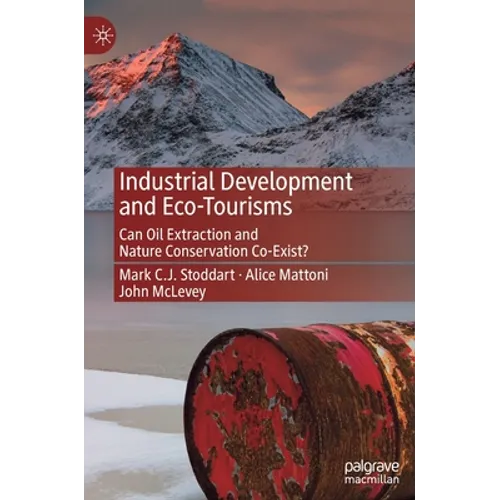
This book examines the "oil-tourism interface", the broad range of direct and indirect contact points between offshore oil extraction and nature-based tourism. Offshore oil extraction and nature-based tourism are pursued as development paths across the North Atlantic region. Offshore oil promises economic benefits from employment and royalty payments to host societies, but is based on fossil fuel-intensive resource extraction. Nature-based tourism, instead, is based on experiencing natural environments and encountering wildlife, including whales, seals, or seabirds. They share social-ecological space, such as oceans, coastlines, cities and towns where tourism and offshore oil operations and offices are located. However, they rarely share cultural or political space, in terms of media coverage, public debate, or policy discussion that integrates both modes of development. Through a comparative analysis of Denmark, Iceland, Newfoundland and Labrador, Norway, and Scotland, this book offers important lessons for how coastal societies can better navigate relationships between resource extraction and nature-based tourism in the interests of social-ecological wellbeing.
Back Jacket
Eco-tourism and extractive industries may seem unlikely bedfellows but the reality is that, in many parts of the world, governments pursue both. By examining the politics and cultures of oil and tourism in the North Atlantic, Stoddart, Mattoni and McLevey shed new light on how contradictions and conflicts between the two development paths are managed and, critically, where opportunities to promote more positive social and ecological futures lie. I thoroughly recommend it. - Stewart Lockie, Distinguished Professor of Sociology, James Cook University, Australia
This book examines the "oil-tourism interface", the broad range of direct and indirect contact points between offshore oil extraction and nature-based tourism. Offshore oil extraction and nature-based tourism are pursued as development paths across the North Atlantic region. Offshore oil promises economic benefits from employment and royalty payments to host societies, but is based on fossil fuel-intensive resource extraction. Nature-based tourism, instead, is based on experiencing natural environments and encountering wildlife, including whales, seals, or seabirds. They share social-ecological space, such as oceans, coastlines, cities and towns where tourism and offshore oil operations and offices are located. However, they rarely share cultural or political space, in terms of media coverage, public debate, or policy discussion that integrates both modes of development. Through a comparative analysis of Denmark, Iceland, Newfoundland and Labrador, Norway, and Scotland, this book offers important lessons for how coastal societies can better navigate relationships between resource extraction and nature-based tourism in the interests of social-ecological wellbeing. Mark C.J. Stoddart is Professor in the Department of Sociology, Memorial University of Newfoundland, Canada. His work appears in: Global Environmental Change, Organization & Environment, Energy Research & Social Science, Environmental Politics, and Environmental Communication.Alice Mattoni is Associate Professor in the Department of Political and Social Sciences at the University of Bologna, Italy. Her work appears in: Communication Theory, European Journal of Communication, Information, Communication and Society, and Social Movement Studies.
John McLevey is Associate Professor in the Departments of Knowledge Integration, Sociology, and Geography & Environmental Management at the University of Waterloo, Canada. His substantive research interests are primarily in the fields of political, cognitive, and environmental social science.
Author Biography
Mark C.J. Stoddart is Professor in the Department of Sociology, Memorial University of Newfoundland, Canada. His work appears in Global Environmental Change, Organization & Environment, Energy Research & Social Science, Environmental Politics, and Environmental Communication.
Alice Mattoni is Associate Professor in the Department of Political and Social Sciences at the University of Bologna, Italy. Her work appears in: Communication Theory, European Journal of Communication, Information, Communication and Society, and Social Movement Studies.
John McLevey is Associate Professor in the Departments of Knowledge Integration, Sociology, and Geography & Environmental Management at the University of Waterloo, Canada. His substantive research interests are primarily in the fields of political, cognitive, and environmental social science.