


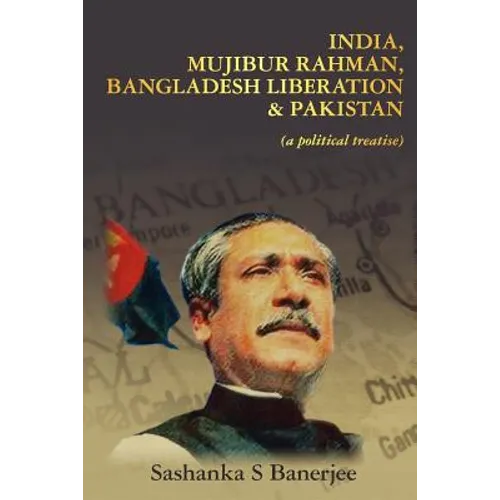
Product Description
by Sashanka S. Banerjee (Author)
Sashanka S Banerjee, the author of this book and retired Indian diplomat, was closely associated with some of the leading figures of the Bangladesh Liberation Struggle. Starting with his first contact with Bangladesh's founding father, Shaikh Mujibur Rahman, in the early 60s, he persuaded Mujib to not only agree a Parliamentary system of Government based on the principles of secularism, but also to appoint Justice Abu Sayeed Choudhury, with whom Banerjee had a strong working relationship, as the first President of Bangladesh. Mujib and Banerjee together sang and informally agreed the national anthem of Bangladesh on a historic flight they shared from London to Dhaka, via Delhi, shortly after the end of the 1971 Bangladesh War. In this first publication of these critical, behind-the-scenes, events, Sashanka Banerjee also recounts his chilling encounters with Mujib's future conspirator, General Ziaur Rahman, and assassin, Colonel Farook Rahman. In spite of Banerjee's dire warnings to Mujib to take heightened security precautions, fondness for his countrymen resulted in his untimely and violent death, and triggered a long souring of the relationship between Bangladesh and India, remote-controlled by Pakistan. With the return to power of Mujib's daughter, Shaikh Hasina, Bangladesh has rediscovered its original path of secular democracy and economic development, whilst ensuring the horrific war crimes of the mass rape and murder of over two million Bangladeshis by Pakistan's soldiers are finally aired and justice brought to bear. This unique insider's account of the Bangladesh Liberation Struggle not only reads like a gripping thriller, it also sets out the historical context of the dawn of Islamic extremism and terrorism emanating from Pakistan. The loss of almost a half of its original territory was a body-blow to the psyche of Pakistan's Punjabi-dominated military rulers. The author argues that the bloody Af-Pak conflict in Central Asia, beginning in 2001 and continuing even today, was born in the battle fields of Bangladesh during the India-Pakistan War of 1971. Fearing further losses to the other ethno-national groups of the Balochis, Pashtuns and Sindhis, the Pakistan military embarked on a self-destructive strategy of the wholesale radicalisation to extreme Islam, hoping it would serve as a glue to keep the country together, giving Pakistan a new national identity. The Army helped establish countrywide Madrassas, religious seminaries, and created and sponsored a host of extremist terrorist groups, from Lashkar e Tayyaba, to the Haqqani Network and the Taliban itself. It engaged in a ferocious proxy war of revenge not only against India but extending it to Afghanistan, and most strikingly against the the United States of America through its close affiliation and protection of Osama Bin Laden and Al Qaeda. The Bangladesh story not only helps to explain the context in which Pakistan embarked on this strategy, it also contains within it the kernel of a democratic resolution. The Bengalis of East Pakistan led by example and chose to fight their way to freedom from the repression and economic stranglehold of Pakistan. Mujib offered to help his fellow ethno-national groups to throw off the shackles of exploitation immediately after Bangladesh secured its own independence. At that time, however, the people of Balochistan, NWFP, and Sind were not able to rally to his call, and emulate the bravery of the Bengalis.
Author Biography
Uniquely qualified - David Petraeus, Director, CIA "Illuminating" - Dr Henry Kissinger



