


Product Description
by Raymond B. Marcin (Author)
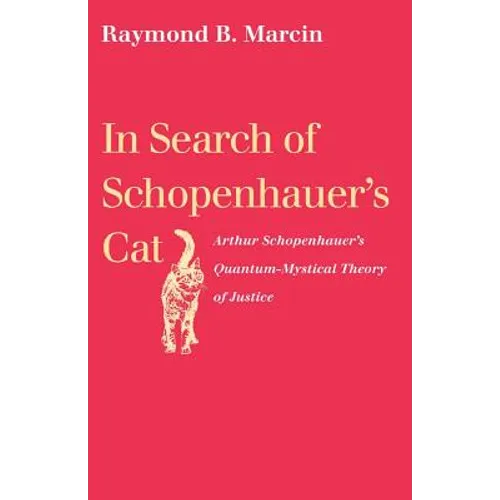
Arthur Schopenhauer's theory of justice is radical. Justice, in Schopenhauer's system of thought, is not an epistemological construct. It is neither rights based nor process based. It rejects the concept of individual moral duty as vehemently as it embraces the concept of collective moral guilt. For Schopenhauer, justice is not a way of assessing reality. It is a facet of reality itself. Schopenhauer's theory of justice is ontology--a study of being itself. In this book Raymond B. Marcin offers several reasons why a review and a reevaluation of Schopenhauer's theory of justice are worthwhile now, almost two hundred years after it was first formulated. One is that his theory of justice, based squarely on his philosophy of being (or ontology), seems remarkably consistent with the view of reality that is taking shape in the minds of contemporary quantum physicists. Albert Einstein called Schopenhauer's writings ""wonderful,"" and Erwin Schrödinger called them ""beautiful."" Another reason is that the metaphysical basis of Schopenhauer's theory of justice bridges a gap that has long existed between Western and Eastern approaches to philosophy and may well have had an influence on the thought of Mohandas K. Gandhi. Yet another reason is that some contemporary jurisprudential movements with a strong social orientation have of late taken an interest in the concept of ""community."" The idea of ""comm-unity"" in its most basic and most literal sense is at the heart of Schopenhauer's deep ontology of justice. Finally, the concept of justice has almost always been examined from an epistemological vantage point. Seldom have we seen, outside the natural law tradition, a metaphysical or ontological examination of justice, and that is exactly what Schopenhauer gives. Readers will learn of Schopenhauer's thought, life, and importance in the history of philosophy. A multi-disciplinary approach combined with the author's inviting style will make this book worth the consideration of a broad range of scholars.
Author Biography
Raymond B. Marcin is professor of law emeritus at the Catholic University of America Law School.



