Product Description
by Leora Batnitzky (Author)
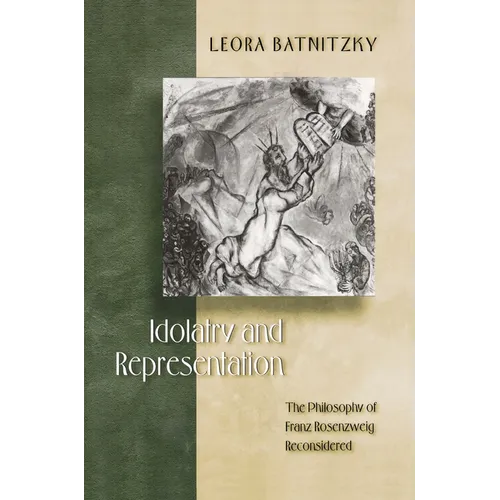
Although Franz Rosenzweig is arguably the most important Jewish philosopher of the twentieth century, his thought remains little understood. Here, Leora Batnitzky argues that Rosenzweig's redirection of German-Jewish ethical monotheism anticipates and challenges contemporary trends in religious studies, ethics, philosophy, anthropology, theology, and biblical studies.
This text, which captures the hermeneutical movement of Rosenzweig's corpus, is the first to consider the full import of the cultural criticism articulated in his writings on the modern meanings of art, language, ethics, and national identity. In the process, the book solves significant conundrums about Rosenzweig's relation to German idealism, to other major Jewish thinkers, to Jewish political life, and to Christianity, and brings Rosenzweig into conversation with key contemporary thinkers. Drawing on Rosenzweig's view that Judaism's ban on idolatry is the crucial intellectual and spiritual resource available to respond to the social implications of human finitude, Batnitzky interrogates idolatry as a modern possibility. Her analysis speaks not only to the question of Judaism's relationship to modernity (and vice versa), but also to the generic question of the present's relationship to the past--a subject of great importance to anyone contemplating the modern statuses of religious tradition, reason, science, and historical inquiry. By way of Rosenzweig, Batnitzky argues that contemporary philosophers and ethicists must relearn their approaches to religious traditions and texts to address today's central ethical problems.Back Jacket
"In Idolatry and Representation, Rosenzweig has found a commentator who has fully absorbed the implications of his fundamental insight, that ethics cannot be separated from logic and aesthetics, that our capacities to stand in for our neighbor, to be there for him or her, are deeply connected to our theories of representation, however explicit they may be. This book, written with philosophical lucidity and moral intensity, will orient discussions of German-Jewish thought for years to come."--Eric Santner, University of Chicago
"This illuminating study offers new, indeed daringly novel, hermeneutical strategies of reading the often exasperatingly complex writings of Franz Rosenzweig, arguably the most towering figure of twentieth-century Jewish thought. By identifying his critique of idolatry--characterized by an improper relation to God--to be the subtext informing Rosenzweig's religious vision, Batnitzky not only allows us to unravel his arguments, but also offers a rich array of insights into the religious condition of contemporary Judaism."--Paul Mendes-Flohr, Hebrew University of Jerusalem
"For a postliberal Christian theologian, reading Batnitzky on Rosenzweig is an unalloyed joy. He is, in her interpretation, the kind of Jewish conversation partner Christians need--a partner who is both more critical of Christianity and also Jewishly self-critical than has been previously supposed. The book contributes greatly to a welcome turn in Jewish-Christian dialogue which is now in progress."--George Lindbeck, Yale University
"Leora Batnitzky is one of the up-and-coming stars in contemporary Jewish philosophy and the philosophy of religion, and this book shows why. The book displays careful, comprehensive scholarship in modern and contemporary Jewish, Christian, and general theology and philosophy. It is a creative, constructive project that displays for our use previously under-seen patterns of hermeneutical and ethical thinking in one of the greatest twentieth-century Jewish figures. It is an urgent book that addresses with academic rigor issues of significant ethical-philosophic import on the border between academe and broader social life."--Peter Ochs, University of Virginia
Author Biography
Leora Batnitzky is Assistant Professor of Religion at Princeton University.