


Product Description
by Maurice Merleau-Ponty (Author), John O'Neill (Translator)
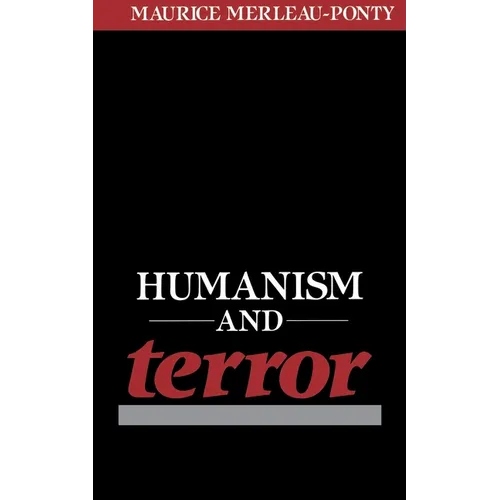
First published in France In 1947, Merleau-Ponty's essay was in part a response to Arthur Koestler's novel, Darkness at Noon, and in a larger sense a contribution to the political and moral debates of a postwar world suddenly divided into two armed camps. For Merleau-Ponty, the basic question was: given the violence in Communism, is Communism still equal to its humanist intentions?
Starting with the assumption that a society is not a "temple of value-idols that figure on the front of its monuments or in its constitutional scrolls; the value of a society is the value It places upon man's relation to man," Merleau-ponty examines not only the Moscow trials of the late thirties but also Koestler's re-creation of them. And Merleau-Ponty makes it clear that the Moscow trials--and violence in general in the Communist world--can be understood only In the context of revolutionary violence. He demonstrates that it is pointless to begin an examination of Communist violence by asking whether Communism respects the rules of liberal thought; it is evident that Communism does not. The question that should be asked is whether the violence Communism exercises is revolutionary violence, capable of building humane relations among men. At a time when many are addressing similar questions to societies both in the East and in the West, Merleau-Ponty's investigations and speculations are of prime importance; they stand as a major and provocative contribution to the argument surrounding the use of violence.
Number of Pages: 240
Dimensions: 0.62 x 8.01 x 5.02 IN
Publication Date: August 01, 2001



