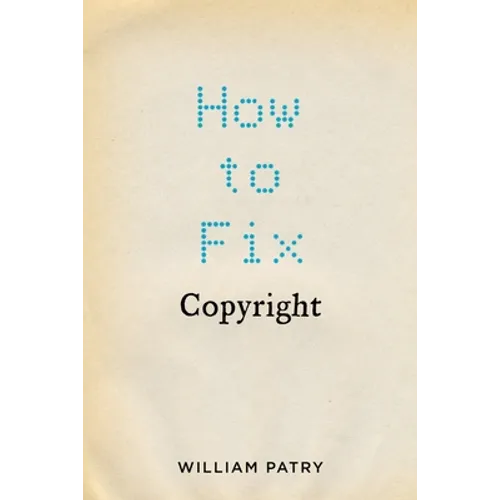
Product Description
by William Patry (Author)
Do copyright laws directly cause people to create works they otherwise wouldn't create? Do those laws directly put substantial amounts of money into authors' pockets? Does culture depend on copyright? Are copyright laws a key driver of competitiveness and of the knowledge economy?
These are the key questions William Patry addresses in How to Fix Copyright. We all share the goals of increasing creative works, ensuring authors can make a decent living, furthering culture and competitiveness and ensuring that knowledge is widely shared, but what role does copyright law actually play in making these things come true in the real world? Simply believing in lofty goals isn't enough. If we want our goals to come true, we must go beyond believing in them; we must ensure they come true, through empirical testing and adjustment. Patry argues that laws must be consistent with prevailing markets and technologies because technologies play a large (although not exclusive) role in creating consumer demand; markets then satisfy that demand. Patry discusses how copyright laws arose out of eighteenth-century markets and technology, the most important characteristic of which was artificial scarcity. Artificial scarcity was created by the existence of a small number gatekeepers, by relatively high barriers to entry, and by analog limitations on copying. Markets and technologies change, in a symbiotic way, Patry asserts. New technologies create new demand, requiring new business models. The new markets created by the Internet and digital tools are the greatest ever: Barriers to entry are low, costs of production and distribution are low, the reach is global, and large sums of money can be made off of a multitude of small transactions. Along with these new technologies and markets comes the democratization of creation; digital abundance is replacing analog artificial scarcity. The task of policymakers is to remake our copyright laws to fit our times: our copyright laws, based on the eighteenth century concept of physical copies, gatekeepers, and artificial scarcity, must be replaced with laws based on access not ownership of physical goods, creation by the masses and not by the few, and global rather than regional markets. Patry's view is that of a traditionalist who believes in the goals of copyright but insists that laws must match the times rather than fight against the present and the future.Author Biography
William Patry is Senior Copyright Counsel at Google Inc. He previously served as copyright counsel to the U.S. House of Representatives, Committee on the Judiciary; as a Policy Planning Advisor to the U.S. Register of Copyrights; as a law professor; and as a private lawyer. He is the author of the definitive eight volume treatise on copyright law, Patry on Copyright, a separate treatise on the fair use doctrine, Patry on Fair Use which has been in print since 1985, as well as many law review articles, including one with Judge Richard Posner.