


Product Description
by Patrick Weil (Author)
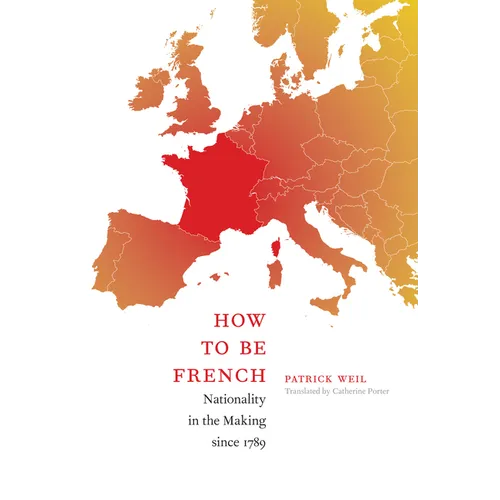
How to Be French is a magisterial history of French nationality law from 1789 to the present, written by Patrick Weil, one of France's foremost historians. First published in France in 2002, it is filled with captivating human dramas, with legal professionals, and with statesmen including La Fayette, Napoleon, Clemenceau, de Gaulle, and Chirac. France has long pioneered nationality policies. It was France that first made the parent's nationality the child's birthright, regardless of whether the child is born on national soil, and France has changed its nationality laws more often and more significantly than any other modern democratic nation. Focusing on the political and legal confrontations that policies governing French nationality have continually evoked and the laws that have resulted, Weil teases out the rationales of lawmakers and jurists. In so doing, he definitively separates nationality from national identity. He demonstrates that nationality laws are written not to realize lofty conceptions of the nation but to address specific issues such as the autonomy of the individual in relation to the state or a sudden decline in population.
Throughout How to Be French, Weil compares French laws to those of other countries, including the United States, Great Britain, and Germany, showing how France both borrowed from and influenced other nations' legislation. Examining moments when a racist approach to nationality policy held sway, Weil brings to light the Vichy regime's denaturalization of thousands of citizens, primarily Jews and anti-fascist exiles, and late-twentieth-century efforts to deny North African immigrants and their children access to French nationality. He also reveals stark gender inequities in nationality policy, including the fact that until 1927 French women lost their citizenship by marrying foreign men. More than the first complete, systematic study of the evolution of French nationality policy, How to be French is a major contribution to the broader study of nationality.
Back Jacket
This remarkable, award-winning book is sure to be extremely well received by English-language audiences. It provides a detailed, rigorous, chronologically wide, broadly comparative, and fascinating history of French nationality. How to Be French" profoundly revises previous knowledge on the topic, and its comparative framework makes it essential reading not only to scholars of France but also to those interested in Germany, the United States, Algeria, and beyond."-- Eric T. Jennings, author of "Curing the Colonizers: Hydrotherapy, Climatology, and French Colonial Spas"
Author Biography
Patrick Weil is Senior Research Fellow at the National Center for Scientific Research (University of Paris, Sorbonne) and a professor at the Paris School of Economics. The author of many books, he was a member of France's Governmental Advisory Council on Integration from 1996 to 2002, and a member of the Presidential Commission created by President Jacques Chirac on the "implementation of the principle of secularism within the French Republic" in 2003. In 1997, following a request from Prime Minister Lionel Jospin, he produced two influential reports on nationality and immigration legislation. Under its original title, Qu'est-ce qu-un Français, How to Be French won the François Furet prize.
Catherine Porter, Professor Emeritus in the Foreign Languages Department at the State University of New York, Cortland, won the Chevalier d'Or des Palmes Académiques for advancing Franco-American relations through translation and teaching.



