


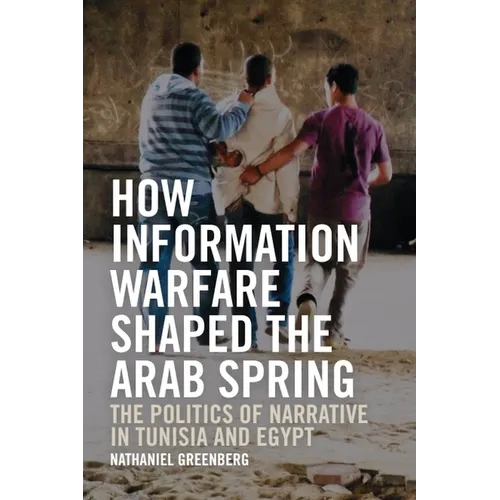
Product Description
by Nathaniel Greenberg (Author)
On January 28 2011 WikiLeaks released documents from a cache of US State Department cables stolen the previous year. The Daily Telegraph in London published one of the memos with an article headlined 'Egypt protests: America's secret backing for rebel leaders behind uprising'. The effect of the revelation was immediate, helping set in motion an aggressive counter-narrative to the nascent story of the Arab Spring. The article featured a cluster of virulent commentators all pushing the same story: the CIA, George Soros and Hillary Clinton were attempting to take over Egypt. Many of these commentators were trolls, some of whom reappeared in 2016 to help elect Donald J. Trump as President of the United States. This book tells the story of how a proxy-communications war ignited and hijacked the Arab uprisings and how individuals on the ground, on air and online worked to shape history.
Front Jacket
'Remarkable in its deft use of various strands of scholarship, its engaging style and its command of the subject... it is intellectually alert and uncompromising, yet it remains empathetic to the human dimension of the Arab Spring.' Philippe-Joseph Salazar, Distinguished Professor in Rhetoric, University of Cape Town On 28 January 2011 WikiLeaks released documents from a cache of US State Department cables stolen the previous year. The Daily Telegraph in London published one of the memos with an article headlined 'Egypt protests: America's secret backing for rebel leaders behind uprising'. The effect of the revelation was immediate, helping set in motion an aggressive counter-narrative to the nascent story of the Arab Spring. The article featured a cluster of virulent commentators all pushing the same story: the CIA, George Soros and Hillary Clinton were attempting to take over Egypt. Many of these commentators were trolls, some of whom reappeared in 2016 to help elect Donald J. Trump as President of the United States. This book tells the story of how a proxy-communications war ignited and hijacked the Arab uprisings and how individuals on the ground, on air and online worked to shape history. Key Features - Includes the author's first-hand perspective of the Arab uprisings which he wrote about from Cairo for The Seattle Times - Features interviews with high-level insiders, including the American Ambassador to Egypt in 2011, Margaret Scobey - Provides a critical survey and analysis of the use of narrative and counter-narrative theories by the US defence-intelligence sector - Discusses how the Tunisian uprising was used by groups like Ansar al-Shari'ah in Tunisia and al-Qaeda in the Islamic Maghreb to advance a radical Islamic agenda - Includes analysis of new trends in cultural production, including the recent boom in science fiction and popular cinema Nathaniel Greenberg is as an Assistant Professor and head of the Arabic program at George Mason University. He is the author of The Aesthetic of Revolution in the Film and Literature of Naguib Mahfouz (1952-1967) and Islamists of the Maghreb with Jeffry R. Halverson. Cover image: Vigilantes, January 30, 2011 (c) Nathaniel Greenberg Cover design: www.paulsmithdesign.com [EUP logo] edinburghuniversitypress.com ISBN 978-1-4744-5395-0 Barcode
Author Biography
Nathaniel Greenberg is the author of 'The Aesthetic of Revolution in the Film and Literature of Naguib Mahfouz (1952-1967)' and 'Islamists of the Maghreb' with Jeffry R. Halverson. He lives in Northern Virginia where he works as an Assistant Professor and Head of the Arabic programme at George Mason University.



