


Product Description
by Krakrafaa Thompson Tenent Bestman (Author)
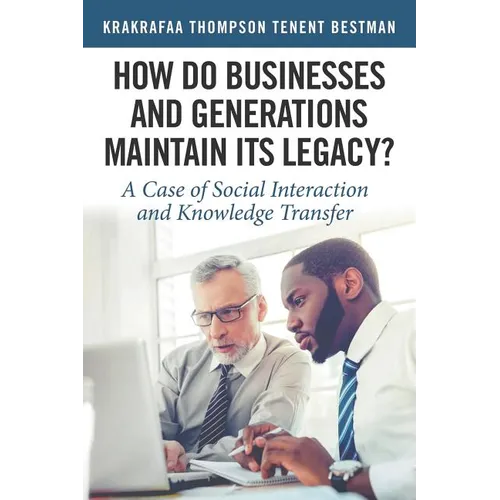
Employees exit an organization with 80% of the knowledge they have acquired without transferring it to others. This colossal loss of intellectual assets is even more in terms of parent to child legacy transfer. Several factors may have contributed to this immense generational memory loss. First, the knowledge seekers do not know what to do on how to influence the knowledge sources to share their skills and experiences and may not even understand the characteristics of the knowledge they intend to access from the knowledge sources. Second, these intellectual assets such as skills and experiences they intend to access give the knowledge sources their comparative advantage in the society and worst still, they are not on the pages of procedures or other documented format, but mainly domicile in the heads of the possessors and hence not visible to others. Third, people also regard their skills and experiences as invaluable intellectual assets and hence do not want to easily share it with others. These are some of the constraints knowledge seekers face, whether in an organization or the society while trying to access the information they require in creating value in their respective domains. Eventually, the legacies transferred to the knowledge seekers fall short of what would have been transferred if the knowledge seeker knows otherwise. This book bridges this gap by providing a strategic and systematic approach on how a knowledge seeker may apply social interaction variables and its hierarchical effect on knowledge transfer to influence a knowledge source to share his or her intellectual assets that he or she might not ordinarily be willing to share with any knowledge seeker.
Author Biography
He is a leader in his community and industry, he holds a bachelor of engineering degree in Electrical and Electronics Engineering from the University of Benin, Nigeria; a master degree in Electrical Engineering from the University of Lagos, Nigeria; an MBA from University of Phoenix, Arizona, USA; and a Doctoral in Organizational Leadership from the Northcentral University, Arizona, USA. He has over two decades of experience in the oil and gas industry, with working experience in consultancy, project management, engineering, procurement, and construction in many countries such as Nigeria, Canada, Britain, France, Romania, and the United States of America in pursuit of technology transfer initiatives. Being conversant with diverse environment and work processes, he has a first-hand experience on how social interaction facilitates knowledge transfer among employees, even technology transfer, which in most cases is patented, and often challenging for a knowledge source to share with a knowledge seeker. He is currently working with NAPIMS, a unit of the Nigerian National Petroleum Corporation. He can be contacted on Krakrafaa@iCloud.com.



