Skip to content
Welcome To Our Store.
100,000+ Products for Home, Medical, Office & Classroom Needs
Search
Skip to product information
1 of 1

Hispanic Technocracy - Hardcover

$198.90 USD
$198.90 USD
Sale Sold out
Shipping calculated at checkout.
In stock (100 units), ready to be shipped

Available Offers

Fastest Delivery Tomorrow With Vip DealOrder within 1 hr 8 mins.

Instant 10% Discount On HDFC Banks Credit/Debit Cards EMI and CreditCard

Secure checkout with
  • American Express
  • Apple Pay
  • Diners Club
  • Discover
  • Google Pay
  • Mastercard
  • PayPal
  • Shop Pay
  • Visa
  • Daily deals
  • Return policy
  • Payment method
  • Help center 24/7

Flight Range: Up to 1,000 meters (3,280 feet)

Maximum Speed: 45 kilometers per hour (28 miles per hour)

For all orders exceeding a value of 100USD shipping is offered for free.

Returns will be accepted for up to 10 days of Customer’s receipt or tracking number on unworn items. You, as a Customer, are obliged to inform us via email before you return the item.

Otherwise, standard shipping charges apply. Check out our delivery Terms & Conditions for more details.

View Product Details
Shopping cart
Product Product subtotal Quantity Price Product subtotal
Hispanic Technocracy - Hardcover
$198.90/ea
$0.00
$198.90/ea $0.00

Product Description

by Daniel Gunnar Kressel (Author)

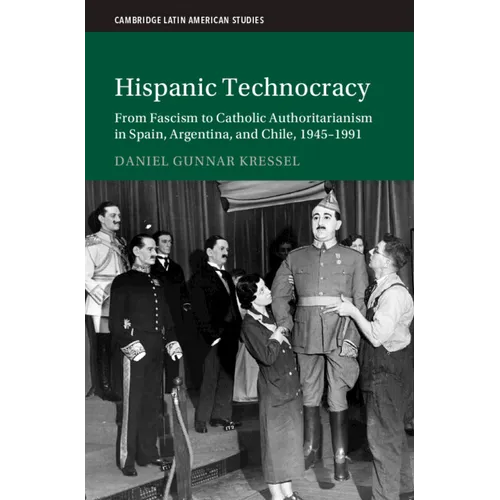
Hispanic Technocracy explores the emergence, zenith, and demise of a distinctive post-fascist school of thought that materialized as state ideology during the Cold War in three military regimes: Francisco Franco's Spain (1939-1975), Juan Carlos Onganía's Argentina (1966-1973), and Augusto Pinochet's Chile (1973-1988). In this intellectual and cultural history, Daniel Gunnar Kressel examines how Francoist Spain replaced its fascist ideology with an early neoliberal economic model. With the Catholic society Opus Dei at its helm amid its 'economic miracle' of the 1960s, it fostered a modernity that was 'European in the means' and 'Hispanic in the ends.' Kressel illuminates how a transatlantic network of ideologues championed this model in Latin America as an authoritarian state model that was better suited to their modernization process. In turn, he illustrates how Argentine and Chilean ideologues adapted the Francoist ideological toolkit to their political circumstances, thereby transcending the original model.


Number of Pages: 302
Dimensions: 0.81 x 9 x 6 IN
Publication Date: August 14, 2025
you might like