


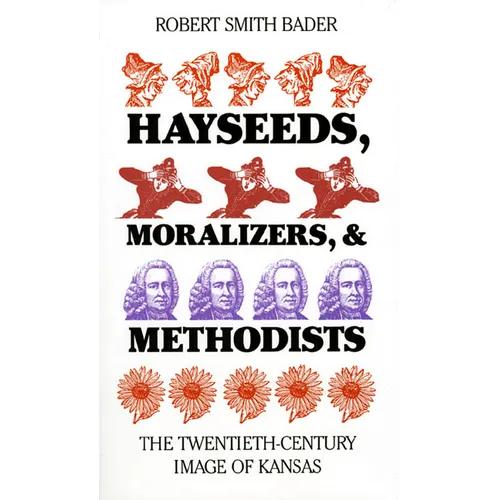
Product Description
by Robert Smith Bader (Author)
Ignobility stalks Kansas in an urban-centered and media-shaped American culture that tilts toward the coasts. The snubs proliferate. In the movie Vacation Chevy Chase contemplates a stop in Kansas at the House of Mud, "the largest free-standing mud dwelling ever built." A novelist skewers the oft-maligned Kansas landscape, "Love a place like Kansas and you can be content in a garden of raked sand," A poster urges the daring to "ski Kansas," and a New Yorker cartoon depicts a highway sign that announces, "You are entering Kansas, or some state very much like it." In the James Bond film Diamonds Are Forever, the evildoers suggest testing their anti-matter weapon on Kansas because "the world wouldn't learn about it for a year." A tee shirt bears the message, "Auntie Em--Hate you. Hate Kansas. Taking the dog. Dorothy."
The tattered image of modern-day Kansas and how it got that way is the subject of Robert Smith Bader's pioneering study. That today's consensus view of Kansas as a drab and backward society has historical roots will surprise few, but many will discover that early in the century Kansas occupied an enviable position in the national psyche. Turn-of-the-century Kansans stood at the threshold of two decades of economic prosperity and of national leadership in the two most prominent socio-political movements of the era--Progressivism and prohibition. During the early 1920s Kansas reached the pinnacle of its influence; the New York times proclaimed it "the national piper" and observed that the rest of the country "dances to her piping." But the Jazz Age discovered livelier music, and Kansas came to epitomize the dry, strait-laced, fundamentalist, and traditional society that the "flaming youth" of the 1920s rejected. To H. L. Mencken, Kansas was the quintessential "cow state," chock-full of hayseeds, moralizers, and Methodists--everything he deplored. With the onset of the Great Depression, which hit Kansas Hard, and the Dust Bowl, the state's reputation plunged precipitously. Criticism without and self-doubt within mounted. By the end of the 1930s Karl A. Menninger was moved to psycho-analyze the entire state and to conclude that it suffered from a pervasive "feeling of inferiority." During the postwar years the popular stereotype of Kansans as " uniformly austere and melancholy, tortured by heat, dust, cold, tornadoes, and their own consciences" matured and took root. By the early 1970s a journalist felt justified in describing Kansas as an "eclipsed state." Bader concludes his study of the rise and fall of the image of Kansas with a marvelous survey of recent popular culture and with a call for a reexamination of the state's historic strengths.


