


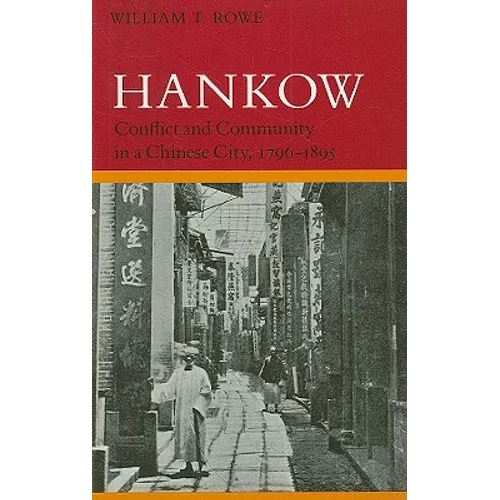
Product Description
by William T. Rowe (Author)
This is the second volume of a two-volume social history of nineteenth-century Hankow, a city of over one million inhabitants and the commercial hub of central China. In the first volume, Hankow: Commerce and Society in a Chinese City, 1796-1889 (1984), the author emphasized the dynamism of late imperial commerce, the relation of the metropolis to its hinterland, and the corporate institutions of the city, notably its guilds, which assumed a number of functions we normally attribute to a municipal government. In this volume, the focus is on the people of Hankow, in all their ethnic diversity, occupational variety, and constant mobility, and on the social bonds that enabled this mass of people to live and work in a crowded city with much less disruptive social conflict than occurred in Hankow's counterparts in early modern Europe.
Built into the argument of the book is a running comparison nineteenth-century Hankow with such cities as London and Paris in the somewhat earlier period when they, too, were experiencing the growing pains of nascent preindustrial capitalism. How are we to account for the fact that the cities of early modern Europe were so much more prone to protest and social upheaval than Hankow was in a comparable stage of development? The author finds the answer in the cultural hegemony of an activist elite that fostered moral consensus, social harmony, and an aura of solicitude for the well-being of residents at every social level, exemplified in such service institutions as poor relief, firefighting, and public security.
Toward the end of the nineteenth century, however, the social bonds that had held Hankow together were beginning to fragment, as social polarization and growing class-consciousness fostered an atmosphere of increasing unrest.
Author Biography
William T. Rowe is Professor of History at Johns Hopkins University.



