


Product Description
by Paul F. Kisak (Author)
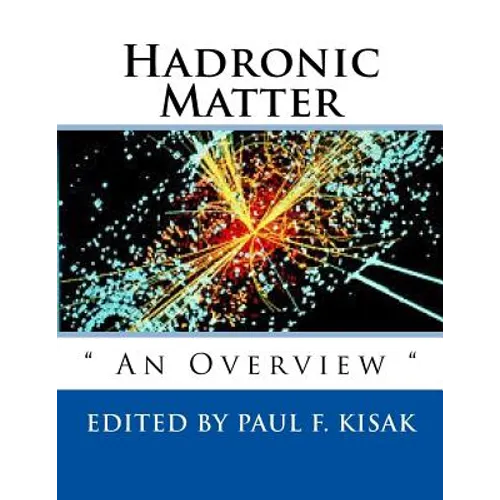
In particle physics a hadron is a composite particle made of quarks held together by the strong force (in a similar way as molecules are held together by the electromagnetic force).Hadrons are categorized into two families: 1) baryons, made of three quarks; and 2) mesons, made of one quark and one antiquark. Protons and neutrons are examples of baryons and pions are an example of a meson. Hadrons containing more than three valence quarks (exotic hadrons) have been discovered in recent years. A tetraquark state (an exotic meson), named the Z(4430) -, was discovered in 2007 by the Belle Collaboration and confirmed as a resonance in 2014 by the LHCb collaboration. Two pentaquark states (exotic baryons), named P+c (4380) and P+c (4450), were discovered in 2015 by the LHCb collaboration. There are several more exotic hadron candidates, and other colour-singlet quark combinations may also exist.Of the hadrons, protons are stable, and neutrons bound within atomic nuclei are stable. Other hadrons are unstable under ordinary conditions and free neutrons decay with a half-life of about 611seconds. Experimentally, hadron physics is studied by colliding protons ornuclei of heavy elements such as lead, and detecting the debris produced in the resulting particle showers.This book gives an concise overview of Hadronic Matter and is designed to be a reference and provide an overview of the topic and give the reader a structured knowledge to familiarize yourself with the topic at the most affordable price possible.The accuracy and knowledge is of an international viewpoint as the edited articles represent the inputs of many knowledgeable individuals and some of the most current knowledge on the topic, based on the date of publication.
Author Biography
The editor has degrees in Engineering Physics & Nuclear Engineering from the University of Michigan and is an Engineer & Former Intelligence Officer for the CIA & US Intelligence Community and was President of an award-winning Defense Contracting Company. He has authored several books, edited numerous books and has written over 75 Technical, Classified & Unclassified papers, Articles & Essays. He has also been a Contributing Author for The International Encyclopedia on Intelligence and Counter-Intelligence and written several award-winning software manuals that have been sold in more than a dozen countries. He has also appeared in Marquis "Who's Who in the World" & "Who's Who in Science & Engineering" and continues to edit and write.