


Product Description
by William L. Hamilton (Author)
Graph-structured data is ubiquitous throughout the natural and social sciences, from telecommunication networks to quantum chemistry. Building relational inductive biases into deep learning architectures is crucial for creating systems that can learn, reason, and generalize from this kind of data. Recent years have seen a surge in research on graph representation learning, including techniques for deep graph embeddings, generalizations of convolutional neural networks to graph-structured data, and neural message-passing approaches inspired by belief propagation. These advances in graph representation learning have led to new state-of-the-art results in numerous domains, including chemical synthesis, 3D vision, recommender systems, question answering, and social network analysis.
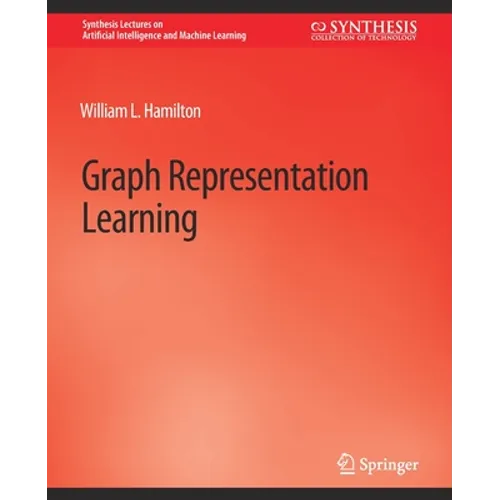
This book provides a synthesis and overview of graph representation learning. It begins with a discussion of the goals of graph representation learning as well as key methodological foundations in graph theory and network analysis. Following this, the book introduces and reviews methods for learning node embeddings, including random-walk-based methods and applications to knowledge graphs. It then provides a technical synthesis and introduction to the highly successful graph neural network (GNN) formalism, which has become a dominant and fast-growing paradigm for deep learning with graph data. The book concludes with a synthesis of recent advancements in deep generative models for graphs--a nascent but quickly growing subset of graph representation learning.
Author Biography
William L. Hamilton is an Assistant Professor of Computer Science at McGill University and a Canada CIFAR Chair in AI. His research focuses on graph representation learning as well as applications in computational social science and biology. In recent years, he has published more than 20 papers on graph representation learning at top-tier venues across machine learning and network science, as well as co-organized several large workshops and tutorials on the topic. Williams work has been recognized by several awards, including the 2018 Arthur L. Samuel Thesis Award for the best doctoral thesis in the Computer Science department at Stanford University and the 2017 Cozzarelli Best Paper Award from the Proceedings of the National Academy of Sciences.