


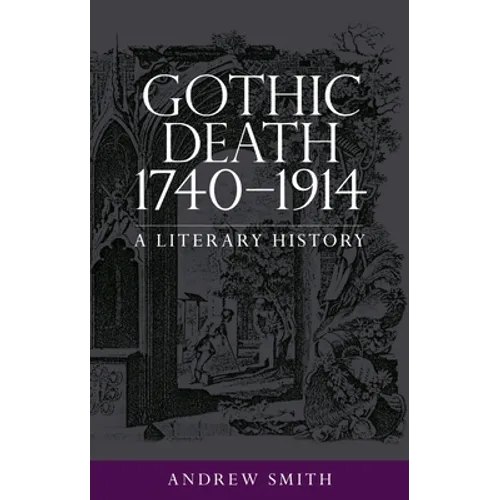
Product Description
by Andrew Smith (Author)
Gothic death 1740-1914 explores the representations of death and dying in Gothic narratives published between the mid-eighteenth century and the beginning of the First World War. The book investigates how eighteenth century Graveyard Poetry and the tradition of the elegy produced a version of death that underpinned ideas about empathy and models of textual composition. Later accounts of melancholy, as in the work of Ann Radcliffe and Mary Shelley, emphasise the literary construction of death. The shift from writing death to interpreting the signs of death is explored in relation to the work of Poe, Emily Brontë and George Eliot. A chapter on Dickens examines the significance of graves and capital punishment during the period. A chapter on Haggard, Stoker and Wilde explores conjunctions between love and death and a final chapter on Machen and Stoker explores how scientific ideas of the period help to contextualise a specifically fin de siècle model of death.
This book will be of interest to academics and students working on literature on the Gothic and more generally on the literary culture of the period.Front Jacket
Gothic death 1740-1914 explores the representations of death and dying in Gothic narratives published between the mid-eighteenth century and the beginning of the First World War. The book challenges ideas about the presence of a Gothic uncanny in the period by exploring how the dead either inspire empathy or become objects of scientific scrutiny. From Graveyard Poetry to the Gothic of the early twentieth century, images of the dead are used to explore ideas about sympathy, mourning and love. This narrative of death in the Gothic is paralleled by a movement from writing to reading in which the cultural emphasis shifts from concerns about how to represent the dead to a focus on decoding the meaning of death. Writers explored include Thomas Gray, Edward Young, Ann Radcliffe, Mary Shelley, James Boaden, Edgar Allan Poe, Emily Brontë, George Eliot, Charles Dickens, Henry Rider Haggard, Bram Stoker, Oscar Wilde and Arthur Machen. Whilst this is a literary history of the representations of death in the Gothic it also explores and explains the various religious, political and scientific contexts which informed this Gothic tradition. This book will be of interest to academics and students working on literature on the Gothic and more generally on the literary culture of the period.
Back Jacket
Gothic death 1740-1914 explores the representations of death and dying in Gothic narratives published between the mid-eighteenth century and the beginning of the First World War. The book challenges ideas about the presence of a Gothic uncanny in the period by exploring how the dead either inspire empathy or become objects of scientific scrutiny. From Graveyard Poetry to the Gothic of the early twentieth century, images of the dead are used to explore ideas about sympathy, mourning and love. This narrative of death in the Gothic is paralleled by a movement from writing to reading in which the cultural emphasis shifts from concerns about how to represent the dead to a focus on decoding the meaning of death.
Writers explored include Thomas Gray, Edward Young, Ann Radcliffe, Mary Shelley, James Boaden, Edgar Allan Poe, Emily Brontë, George Eliot, Charles Dickens, Henry Rider Haggard, Bram Stoker, Oscar Wilde and Arthur Machen. Whilst this is a literary history of the representations of death in the Gothic it also explores and explains the various religious, political and scientific contexts which informed this Gothic tradition. This book will be of interest to academics and students working on literature on the Gothic and more generally on the literary culture of the period.Author Biography
Andrew Smith is Reader in Nineteenth-Century Literature at the University of Sheffield



