Product Description
by O. V. Brantley (Editorial Coordination by)
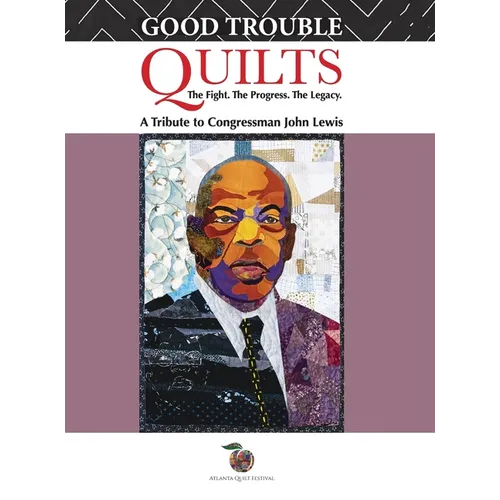
Good Trouble Quilts - The Fight. The Progress. The Legacy.
A Tribute to Congressman John Lewis
Why John Lewis by Sharbreon Plummer
Rep. John Lewis' life and legacy was one dedicated to fighting for the freedoms of his people. Over the course of his lifetime, he remained rooted in the struggle for Black liberation, especially in the South, and witnessed social progress that blossomed from the seeds he planted in his youth. No stranger to the plight of everyday Black people, Lewis was born the son of sharecroppers in the town of Troy, Alabama. A child of the segregated South, his formative years were shaped by the messages and teachings of figureheads such as Rev. Martin Luther King, Jr. The Montgomery Bus Boycott was specifically a catalyzing moment for Lewis, activating him to join in the movement for civil rights.
While attending the American Baptist Theological Seminary in 1959, he began actively participating in workshops to build his understanding of nonviolent demonstration. Two years later, he would find himself at the epicenter of organizing sit-ins at segregated lunch counters in Nashville. When reflecting on his early demonstrations, Lewis stated:
"Sometimes we'd sit for two or three hours. We'd have our books and we'd just sit quietly, doing our homework. Then someone might walk up and hit us or spit on us or do something, but it was very quiet. When I look back on that particular period in Nashville, the discipline, the dedication and the commitment to nonviolence was unbelievable."
Despite being brutalized and jailed for his actions, he would continue to join fellow students on the historic Freedom Rides, which were a call to action against the segregation of interstate buses. Lewis' tenacity also led to him advancing as the chairman of the Student Nonviolent Coordinating Committee (SNCC) in 1963. Through radical action and coalition building, SNCC provided students a pathway into civil rights leadership-to take up the mantle of Black activism in the next generation. Lewis embodied this charge and used his first year to co-organize the March on Washington, where Dr. King delivered his famed I Have a Dream speech and coordinated several initiatives connected to Mississippi Freedom Summer in 1964.
However, March 7, 1965 would soon become another critical point in his life and career trajectory. Also known as Bloody Sunday, Lewis and hundreds of peers would be met with extreme violence at the hands of Alabama police as they peacefully crossed the Edmund Pettus Bridge in Selma. With a bloodied, fractured skull, Lewis delayed treatment to appear on television with a call for presidential intervention and immediate action.
Following his time at SNCC, Lewis held various positions in the public sector from 1966-1980, and secured his first seat in political office in 1981 as a member of Atlanta's City Council. Following the completion of his term in 1986, he was voted into Congress as a representative of the 5th District of Georgia. A testament to his impact, Lewis was re-elected 16 times and served as a Representative until 2020. Even into his later years, Lewis remained committed to his cause and calling. From protesting the violence in Darfur in 2009 to leading a Democratic sit-in for gun control in 2016, Rep. John Lewis will forever be remembered as a beacon of good trouble for generations to come.