


Product Description
by Colin D. MacLeod (Author)
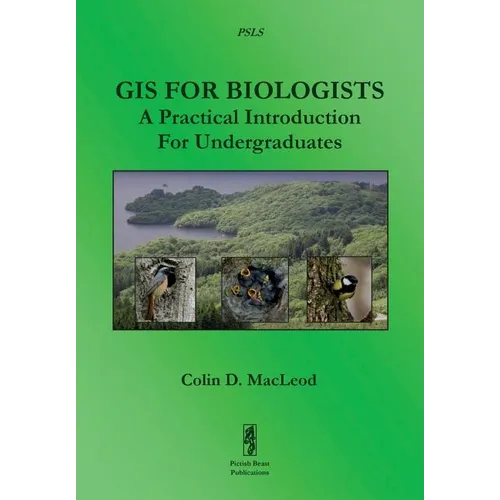
This book provides a user-friendly and practical introduction for undergraduates to the use of Geographic Information Systems (GIS) in biological research. Unlike most other books about using GIS, this information is specifically presented in a biological context and it is divided into two sections.
The first section provides just enough background information to allow the novice biological GIS user to get started with GIS without getting too bogged down in the theory behind it or making some of the most common mistakes made by beginners. It covers areas such as what GIS is, why GIS is useful in biology, the basics of GIS, common concepts and terms in GIS, how data are contained in a GIS, useful information about what to think about before starting a GIS project and how to break down and translate ecological tasks into the language of GIS. This information is all provided in easy-to-read and non-technical language, with specific reference to its application in biological research.
The second section, which constitutes the main body of the book, consists of six practical exercises accompanied by detailed instruction sets. The first four exercises introduce the novice biological GIS user to basic, but important, GIS skills, such as making a map, creating new feature data layers, creating raster data layers and joining together data from different data layers. The final two consist of case studies of how GIS can be used to answer real biological research questions. Each of these exercises represents a stand-alone GIS lesson which can be completed either on its own or as part of a practical session for an undergraduate class. In addition, each exercise focuses on a different area of biology, such as tropical ornithology, epidemiology, marine biology and rainforest ecology, and on a different part of the world, including the Amazon rainforest, a Scottish field station, Mount Mabu in northern Mozambique, the North Atlantic Ocean and the USA. Instructions for each exercise are provided for both the leading commercial GIS package (ESRI's ArcGIS(R) 10.3 software) and the leading freely available open-source GIS software (QGIS 2.8.3, also known as Quantum GIS), meaning that this book can be used to learn, or teach, how to use of GIS in biological research, regardless of the availability of commercial software licences. Taken together, the two sections of this book provide the perfect primer to show undergraduates, and other novice GIS users, how useful GIS can be in biological research, why it is rapidly becoming a key skill in many areas of biology, and how start in using it.
The PSLS series of books uses Task-Oriented Learning (TOL) to teach the practical application of research skills to the life sciences. This involves demonstrating how these skills can be used in the specific circumstances in which they are likely to be required, rather than concentrating on teaching theoretical frameworks or on teaching skills in a generic or abstract manner. By seeing how the similar processes are used to achieve a variety of different goals within a specific field, it becomes easier for the reader to identify the general rules behind the practical application of these processes and, therefore, to transfer them to novel situations they may encounter in the future.