


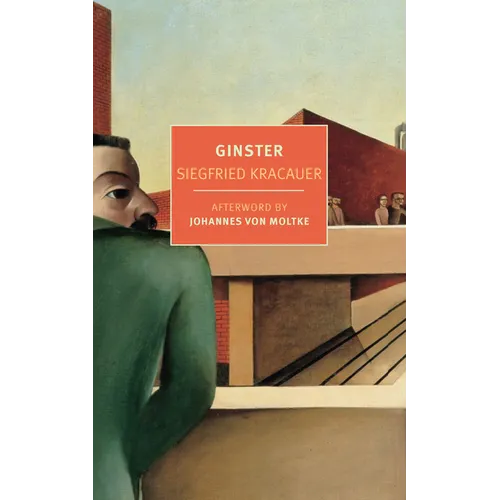
Product Description
by Siegfried Kracauer (Author), Carl Skoggard (Translator), Johannes Von Moltke (Afterword by)
When World War I breaks out, a young architecture student in Munich does everything in his power to avoid being enlisted into the German military in this perceptive, wickedly humorous novel by a prominent twentieth-century writer, journalist, and film critic.
Ginster is a war novel about not going to war; about how war, far from the front, comes to warp every aspect of outer and inner life and to infect the workings of language itself. The subject is World War I, but this novel by the brilliant twentieth-century sociologist, journalist, and film critic Siegfried Kracauer, first published in 1928, has as much to say about what it means to live under the sulking great powers and blood-imbrued satrapies of today as it does about the inflamed self-righteousness of late imperial Germany. In Ginster, as in Greek tragedy, massacre occurs offstage, arriving only as "news," but the everyday horror of a society engineered for the continual production of violence is not to be denied. Ginster, the Chaplinesque antihero, intent chiefly on saving his own skin, works hard to keep his distance from the war machine, and yet making a living, he discovers, is all about keeping it running. How different, in the end, is his dreamy self-absorption from the empty military language that has come to pervade every aspect of civilian life in the homeland?Author Biography
Siegfried Kracauer (1889-1966) was born and raised in Frankfurt am Main. Perhaps best known for his pioneering studies in sociology and film theory, he initially trained as an engineer and architect, emerging in the Weimar years as a gifted journalist. When the Nazis came to power in early 1933, he was chief of the Berlin bureau of the left-leaning Frankfurter Zeitung. He fled, first to France and then, in 1941, to the United States, where he resolved to write only in English. His From Caligari to Hitler: A Psychological History of the German Film (1947) and his magnum opus, Theory of Film: The Redemption of Physical Reality (1960), were completed in New York, where he spent time working in the film library of the Museum of Modern Art and at Columbia University. Kracauer's novels--Ginster (1928) and Georg (1934, first published in 1963)--testify to his dramatic about-face from literary expressionism to the New Objectivity of the 1920s. Theodore Adorno, who spoke of Ginster as Kracauer's most notable achievement, paid tribute to his lifelong friend on his seventy-fifth birthday by claiming that as a young man he had already learned more about the study of philosophy from Siegfried Kracauer than he ever did from any of his academic teachers.
Carl Skoggard is a writer and translator living in Valatie, New York. He has produced annotated English versions of works by Walter Benjamin, Thomas Bernhard, Robert Walser, and others. His most recently completed translation is Klaus Mann's The Volcano: A Novel Among Emigrants. Johannes von Moltke is the Rudolf Arnheim Collegiate Professor of German Studies and Film, Media & Television at the University of Michigan. He is the author of The Curious Humanist: Siegfried Kracauer in America and a coeditor of Last Letters: The Prison Correspondence, 1944-45 by Freya and Helmuth James von Moltke (published by New York Review Books).