


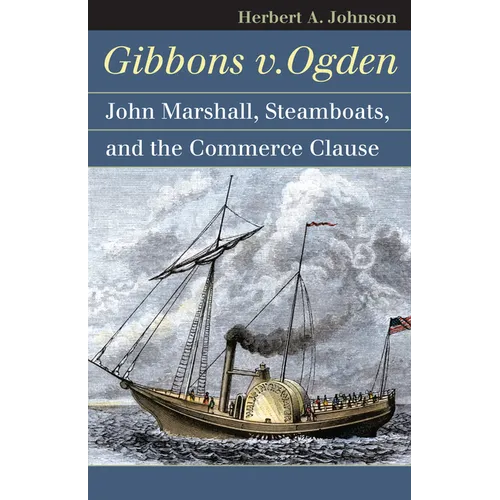
Product Description
by Herbert A. Johnson (Author)
What began as a standoff between competing steamship entrepreneurs ended as one of the Supreme Court's most significant cases. Gibbons v. Ogden in 1824 brought into sharp relief the ongoing tug-of-war for power between individual states and the federal government. By applying the Commerce Clause of the Constitution, the Court set a key precedent for federal authority. But, behind the scenes, the "Steamboat Case" also demonstrated Chief Justice John Marshall's instrumental role as mediator on the bench.
Untangling the issues and the arguments in Gibbons, Herbert Johnson reveals the lasting impact of this landmark case on both commerce in the Early Republic and the understanding and growth of federal power during the last 200 years. Johnson brings the case's protagonists--including Marshall and Daniel Webster--vividly to life and deftly illuminates its key aspects: the ambiguity of the Court's judgment; Justice William Johnson's nationalist-oriented concurring opinion; Marshall's avoidance of such key issues as the role of the dormant commerce clause and the relationship of foreign trade, interstate commerce, and diplomatic relations; and Marshall's failure to address patents and state monopolies. Perhaps most significant, the author challenges the traditional view that Gibbons established that the Constitution bestowed upon Congress an exclusive power to regulate interstate commerce. Drawing on recent research into the early Court, Johnson shows how Gibbons provides a salient example of Marshall's ability to gain agreement despite severe differences among his colleagues. No longer surrounded by fellow Federalists on the bench, Marshall mustered all of his managerial skills to achieve consensus, and his opinion for the Court reflected the concessions and agreements that he engineered to achieve near unanimity in a decision that favored federal power without establishing a definitive endorsement of it. Johnson shows that the outcome of this case was a key moment in the economic history of the nation, heralding the expansion of entrepreneurship and technology while justifying federal primacy in the regulation of commerce. Concise and ideally suited for the classroom, his study not only provides new insight into this landmark case but also attests to its significance in the working of the early Court.
Number of Pages: 216
Dimensions: 0.56 x 5.56 x 6.9 IN
Publication Date: September 02, 2010