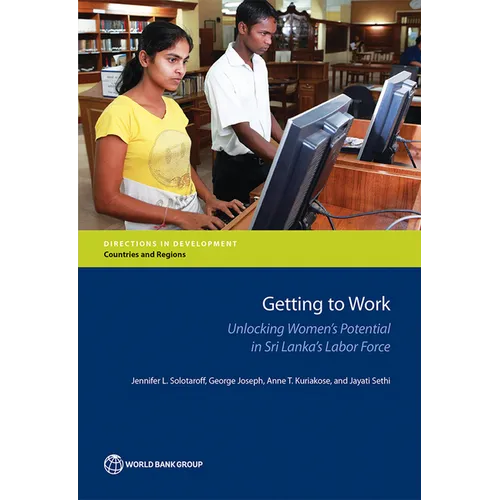
Product Description
by Jennifer L. Solotaroff (Author), George Joseph (Author), Anne Kuriakose (Author)
Sri Lanka has shown remarkable persistence in low female labor force participation rates--at
36 percent from 2015 to 2017, compared with 75 percent for same-aged men--despite overall
economic growth and poverty reduction over the past decade. The trend stands in contrast to the
country's achievements in human capital development that favor women, such as high levels of
female education and low total fertility rates, as well as its status as an upper-middle-income
country.
This study intends to better understand the puzzle of women's poor labor market outcomes in
Sri Lanka. Using nationally representative secondary survey data--as well as primary qualitative
and quantitative research--it tests three hypotheses that would explain gender gaps in labor
market outcomes: (1) household roles and responsibilities, which fall disproportionately on
women, and the associated sociophysical constraints on women's mobility; (2) a human capital
mismatch, whereby women are not acquiring the proper skills demanded by job markets; and
(3) gender discrimination in job search, hiring, and promotion processes. Further, the analysis
provides a comparison of women's experience of the labor market between the years leading up
to the end of Sri Lanka's civil war (2006+"09) and the years following the civil war (2010+"15).
The study recommends priority areas for addressing the multiple supply- and demand-side factors
to improve women's labor force participation rates and reduce other gender gaps in labor market
outcomes. It also offers specific recommendations for improving women's participation in the five
private sector industries covered by the primary research: commercial agriculture, garments,
tourism, information and communication technology, and tea estate work.
The findings are intended to influence policy makers, educators, and employment program
practitioners with a stake in helping Sri Lanka achieve its vision of inclusive and sustainable job
creation and economic growth. The study also aims to contribute to the work of research
institutions and civil society in identifying the most effective means of engaging more women--
and their untapped potential for labor, innovation, and productivity--in Sri Lanka's future.