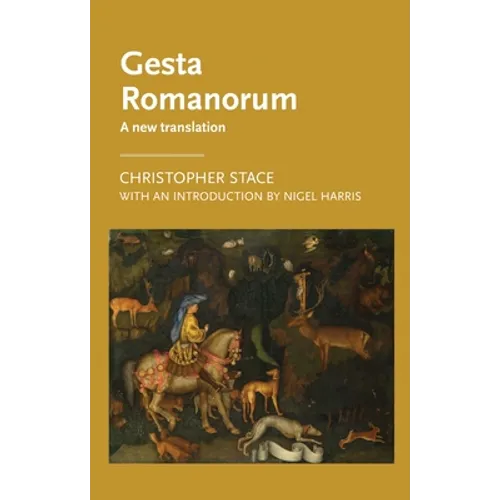
Product Description
by Christopher Stace (Translator), Nigel Harris (Introduction by)
This volume contains an entirely new and accessible translation into modern English of the medieval Latin Gesta Romanorum. Based on the standard Gesta edition by Hermann Österley, it is the first such translation to appear since 1824, and the first to take appropriate account of modern scholarly priorities. The Gesta Romanorum are tales drawn from a wide variety of sources, such as classical mythology, legend and historical chronicles, and are accompanied in almost every case by allegorical Christian interpretations. They were enormously popular throughout the Middle Ages, and had a huge influence on many other authors, such as Boccaccio, Chaucer, Gower, Hoccleve, Shakespeare, Bernard Shaw and Thomas Mann. The Gesta is therefore a foundational work of western European literature - as well as one whose lively, well-crafted and often entertaining narratives hold a continuing appeal for contemporary readers.
Front Jacket
The Gesta Romanorum, compiled in the late thirteenth or early fourteenth century, is one of the primary sources of western European literature. It is an anonymous collection of 180 canonical tales and moralizations written in Latin and drawn from a wide variety of sources: mythology, legend, classical narratives, chronicles and Eastern allegorical stories. This book provides the first modern, scholarly English translation of this valuable medieval text. The title ('Deeds of the Romans') is misleading as only some of the stories concern the Romans. The tales were used by preachers to teach the Christian virtues and explain theological doctrine. The moralizations (allegorical interpretations) that follow them repeatedly emphasize the need for repentance, confession and penance as the threefold way to salvation. The Gesta were immensely popular in their day as the large number of manuscripts and printed editions attest and had a huge influence on subsequent literature. The tales served as models for works by Boccaccio, Chaucer, Gower, Hoccleve and Shakespeare as well as more modern writers such as George Bernard Shaw and Thomas Mann. Some of the Gesta were translated into English c.1510 by or for Wynkyn de Worde; then in 1521 a French translation appeared, Le Violier des Histoires Romaines. The first full English translation was produced by the Revd Charles Swan in 1824 but it amounted to little more than a bowdlerization and the moralizations were treated in cavalier fashion. Here for the first time is a faithful English translation of the Gesta printed in Hermann Österley's 1872 edition, with full introduction, bibliography and notes. Gesta Romanorum will appeal to students and lecturers in English Literature, Medieval Studies and Medieval Latin.
Back Jacket
The Gesta Romanorum, compiled in the late thirteenth or early fourteenth century, is one of the primary sources of western European literature. It is an anonymous collection of 180 canonical tales and moralizations written in Latin and drawn from a wide variety of sources: mythology, legend, classical narratives, chronicles and Eastern allegorical stories. This book provides the first modern, scholarly English translation of this valuable medieval text.
The title ('Deeds of the Romans') is misleading as only some of the stories concern the Romans. The tales were used by preachers to teach the Christian virtues and explain theological doctrine. The moralizations (allegorical interpretations) that follow them repeatedly emphasize the need for repentance, confession and penance as the threefold way to salvation. The Gesta were immensely popular in their day as the large number of manuscripts and printed editions attest and had a huge influence on subsequent literature. The tales served as models for works by Boccaccio, Chaucer, Gower, Hoccleve and Shakespeare as well as more modern writers such as George Bernard Shaw and Thomas Mann. Some of the Gesta were translated into English c.1510 by or for Wynkyn de Worde; then in 1521 a French translation appeared, Le Violier des Histoires Romaines. The first full English translation was produced by the Revd Charles Swan in 1824 but it amounted to little more than a bowdlerization and the moralizations were treated in cavalier fashion. Here for the first time is a faithful English translation of the Gesta printed in Hermann Österley's 1872 edition, with full introduction, bibliography and notes. Gesta Romanorum will appeal to students and lecturers in English Literature, Medieval Studies and Medieval Latin.Author Biography
Christopher Stace is an Independent Scholar and Translator
Nigel Harris is Reader in German at the University of Birmingham