


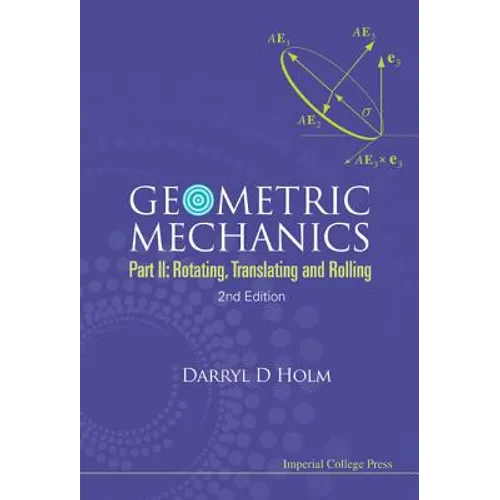
Product Description
by Darryl D. Holm (Author)
See also GEOMETRIC MECHANICS -- Part I: Dynamics and Symmetry (2nd Edition) This textbook introduces modern geometric mechanics to advanced undergraduates and beginning graduate students in mathematics, physics and engineering. In particular, it explains the dynamics of rotating, spinning and rolling rigid bodies from a geometric viewpoint by formulating their solutions as coadjoint motions generated by Lie groups. The only prerequisites are linear algebra, multivariable calculus and some familiarity with Euler-Lagrange variational principles and canonical Poisson brackets in classical mechanics at the beginning undergraduate level.The book uses familiar concrete examples to explain variational calculus on tangent spaces of Lie groups. Through these examples, the student develops skills in performing computational manipulations, starting from vectors and matrices, working through the theory of quaternions to understand rotations, then transferring these skills to the computation of more abstract adjoint and coadjoint motions, Lie-Poisson Hamiltonian formulations, momentum maps and finally dynamics with nonholonomic constraints.The organisation of the first edition has been preserved in the second edition. However, the substance of the text has been rewritten throughout to improve the flow and to enrich the development of the material. Many worked examples of adjoint and coadjoint actions of Lie groups on smooth manifolds have also been added and the enhanced coursework examples have been expanded. The second edition is ideal for classroom use, student projects and self-study.
Front Jacket
This textbook introduces the tools and language of modern geometric mechanics to advanced undergraduate and beginning graduate students in mathematics, physics, and engineering. It treats the dynamics of rotating, spinning and rolling rigid bodies from a geometric viewpoint, by formulating their solutions as coadjoint motions generated by Lie groups. The only prerequisites are linear algebra, multivariable calculus and some familiarity with Euler Lagrange variational principles and canonical Poisson brackets in classical mechanics at the beginning undergraduate level.
Variational calculus on tangent spaces of Lie groups is explained in the context of familiar concrete examples. Through these examples, the student develops skills in performing computational manipulations, starting from vectors and matrices, working through the theory of quaternions to understand rotations, and then transferring these skills to the computation of more abstract adjoint and coadjoint motions, Lie Poisson Hamiltonian formulations, momentum maps and finally dynamics with nonholonomic constraints.
The 120 Exercises and 55 Worked Answers help the student to grasp the essential aspects of the subject, and to develop proficiency in using the powerful methods of geometric mechanics. In addition, all theorems are stated and proved explicitly. The book's many examples and worked exercises make it ideal for both classroom use and self-study.