


Product Description
by Kathleen Fitzpatrick (Author)
Can the university solve the social and political crisis in America?
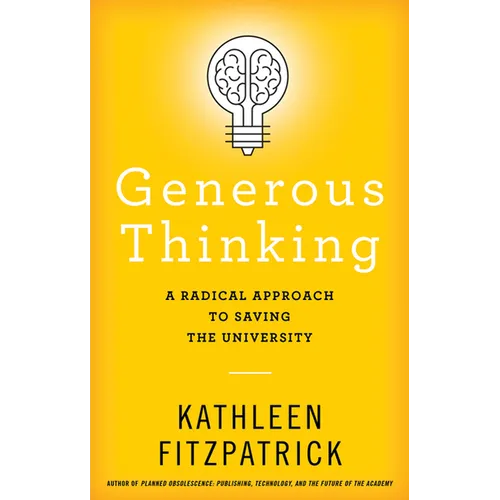
Higher education occupies a difficult place in twenty-first-century American culture. Universities--the institutions that bear so much responsibility for the future health of our nation--are at odds with the very publics they are intended to serve. As Kathleen Fitzpatrick asserts, it is imperative that we re-center the mission of the university to rebuild that lost trust. Critical thinking--the heart of what academics do--can today often negate, refuse, and reject new ideas.
In an age characterized by rampant anti-intellectualism, Fitzpatrick charges the academy with thinking constructively rather than competitively, building new ideas rather than tearing old ones down. She urges us to rethink how we teach the humanities and to refocus our attention on the very human ends--the desire for community and connection--that the humanities can best serve. One key aspect of that transformation involves fostering an atmosphere of what Fitzpatrick dubs "generous thinking," a mode of engagement that emphasizes listening over speaking, community over individualism, and collaboration over competition.
Fitzpatrick proposes ways that anyone who cares about the future of higher education can work to build better relationships between our colleges and universities and the public, thereby transforming the way our society functions. She encourages interested stakeholders to listen to and engage openly with one another's concerns by reading and exploring ideas together; by creating collective projects focused around common interests; and by ensuring that our institutions of higher education are structured to support and promote work toward the public good. Meditating on how and why we teach the humanities, Generous Thinking is an audacious book that privileges the ability to empathize and build rather than simply tear apart.
Back Jacket
Higher education occupies a difficult place in twenty-first-century American culture. Universities--the institutions that bear so much responsibility for the future health of our nation--are at odds with the very publics they are intended to serve. As Kathleen Fitzpatrick asserts, it is imperative that we re-center the mission of the university to rebuild that lost trust. Critical thinking--the heart of what academics do--can today often negate, refuse, and reject new ideas.
In an age characterized by rampant anti-intellectualism, Fitzpatrick charges the academy with thinking constructively rather than competitively, building new ideas rather than tearing old ones down. She urges us to rethink how we teach the humanities and to refocus our attention on the very human ends--the desire for community and connection--that the humanities can best serve. One key aspect of that transformation involves fostering an atmosphere of what Fitzpatrick dubs "generous thinking," a mode of engagement that emphasizes listening over speaking, community over individualism, and collaboration over competition.
Fitzpatrick proposes ways that anyone who cares about the future of higher education can work to build better relationships between our colleges and universities and the public, thereby transforming the way our society functions. She encourages interested stakeholders to listen to and engage openly with one another's concerns by reading and exploring ideas together; by creating collective projects focused around common interests; and by ensuring that our institutions of higher education are structured to support and promote work toward the public good. Meditating on how and why we teach the humanities, Generous Thinking is an audacious book that privileges the ability to empathize and build rather than simply tear apart.
"An inspiring and convincing look at how anyone involved in higher education can nurture generosity and help integrate their institutions into their communities to further the public good. With its call for generosity and community-building that is potentially revolutionary, Kathleen Fitzpatrick's Generous Thinking is an indispensable addition to conversations on the state of higher education today."--Foreword Reviews
"For anyone concerned with the future of higher education, Fitzpatrick makes a passionate argument for a simple yet potentially revolutionary idea."--Library Journal
"Generous Thinking offers us a plan to move our national thinking about higher education in a way that enlivens our democracy."--The Baffler
"Generous Thinking is one important step toward recovering the lost value of the university. [Fitzpatrick's] work, which clearly demonstrates how to think generously in the academy, can help make the case for increased public investment in higher education."--Public Books
Author Biography
Kathleen Fitzpatrick is the director of Digital Humanities and a professor of English at Michigan State University. She is the author of Planned Obsolescence: Publishing, Technology, and the Future of the Academy and The Anxiety of Obsolescence: The American Novel in the Age of Television.