Skip to content
Save 5% on your next order with code PREMIUM5!
100,000+ Products for Home, Medical, Office & Classroom Needs
Search
Skip to product information
1 of 1

Gas turbine blade vibration - Paperback

$76.21 USD
$76.21 USD
Sale Sold out
Shipping calculated at checkout.
In stock (100 units), ready to be shipped

Available Offers

Fast delivery available on most orders

Multiple secure payment options accepted

Secure checkout with
  • American Express
  • Apple Pay
  • Diners Club
  • Discover
  • Google Pay
  • Mastercard
  • PayPal
  • Shop Pay
  • Visa

Flight Range: Up to 1,000 meters (3,280 feet)

Maximum Speed: 45 kilometers per hour (28 miles per hour)

For all orders exceeding a value of 100USD shipping is offered for free.

Returns will be accepted for up to 10 days of Customer’s receipt or tracking number on unworn items. You, as a Customer, are obliged to inform us via email before you return the item.

Otherwise, standard shipping charges apply. Check out our delivery Terms & Conditions for more details.

View Product Details
Shopping cart
Product Product subtotal Quantity Price Product subtotal
Gas turbine blade vibration - Paperback
$76.21/ea
$0.00
$76.21/ea $0.00

Product Description

by Adam Raczyński (Author)

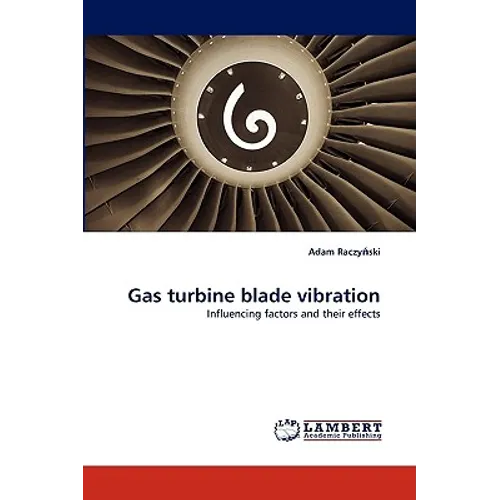
Blade vibration is one of the most significant causes of high cycle fatigue failure in gas turbine engines. A correctly conducted modal analysis can accurately predict the values of natural frequency. The most commonly used tool for such purpose is software based on Finite Element Method. Compared to experimental tests it is less costly, more time efficient and can incorporate phenomena which are not possible to include in experimental measurements. To perform such analysis correctly one must be aware of several significant parameters that should not be omitted in the model definition. This work focuses on main influencing factors such as working temperature, rotational speed, blade root stiffness and examines their effects. In addition it studies the importance of boundary conditions in the FEM model and verifies possible geometrical simplifications that could optimize the solution process. This analysis should be useful to engineers working on turbine blade vibration. The conclusions contained in the work can serve as guidelines for optimizing the process of turbine blade modal analysis and may help FE software users to obtain most accurate results in the least time.

Number of Pages: 64
Dimensions: 0.15 x 9 x 6 IN
Publication Date: July 06, 2010
you might like