Product Description
by Ivan Malara (Author)
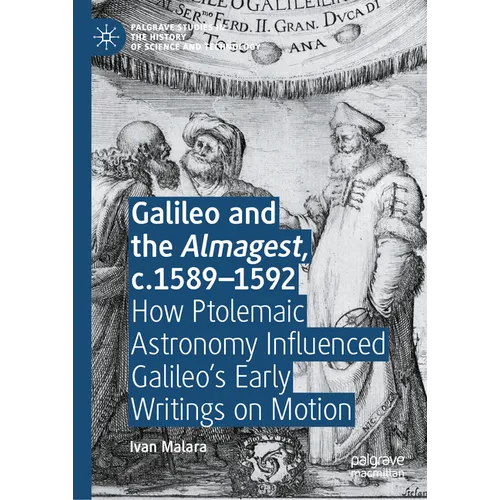
This book offers a groundbreaking exploration of Galileo Galilei's engagement with the Almagest, Claudius Ptolemy's second-century scientific work on the motions of stars and planetary paths. Contrary to the belief that Galileo had little interest in Ptolemaic astronomy, the author investigates whether Ptolemy influenced Galileo's shift to Copernicanism, the theory that Earth and all other planets revolve around the Sun. This inquiry is pursued through a detailed examination of Galileo's early writings on motion, namely the so-called De motu antiquiora (c. 1589-1592). By contextualizing Galileo's initial reception of Ptolemy, the book reveals a fascinating historical backdrop, highlighting how the Almagest was intended to be read and studied in Galileo's milieu during the last decades of the sixteenth century. The author challenges the conventional 'Ptolemaic-Aristotelian' label by showing that early Galileo adhered to a Ptolemaic, yet non-Aristotelian, cosmology supported by an Archimedean-like rationale. Additionally, the book underscores the often-overlooked impact of Theon of Alexandria's commentary on the Almagest in the sixteenth- and seventeenth-century reception of Ptolemy, suggesting it as one of Galileo's potential sources. Offering valuable insights for historians of science and early modern astronomy, this book illuminates Galileo's intricate relationship with astronomical and philosophical ideas, emphasizing the need to re-examine his intellectual journey within a nuanced historical framework.
Back Jacket
This book offers a groundbreaking exploration of Galileo Galilei's engagement with the Almagest, Claudius Ptolemy's second-century scientific work on the motions of stars and planetary paths. Contrary to the belief that Galileo had little interest in Ptolemaic astronomy, the author investigates whether Ptolemy influenced Galileo's shift to Copernicanism, the theory that Earth and all other planets revolve around the Sun. This inquiry is pursued through a detailed examination of Galileo's early writings on motion, namely the so-called De motu antiquiora (c. 1589-1592). By contextualizing Galileo's initial reception of Ptolemy, the book reveals a fascinating historical backdrop, highlighting how the Almagest was intended to be read and studied in Galileo's milieu during the last decades of the sixteenth century. The author challenges the conventional 'Ptolemaic-Aristotelian' label by showing that early Galileo adhered to a Ptolemaic, yet non-Aristotelian, cosmology supported by an Archimedean-like rationale. Additionally, the book underscores the often-overlooked impact of Theon of Alexandria's commentary on the Almagest in the sixteenth- and seventeenth-century reception of Ptolemy, suggesting it as one of Galileo's potential sources. Offering valuable insights for historians of science and early modern astronomy, this book illuminates Galileo's intricate relationship with astronomical and philosophical ideas, emphasizing the need to re-examine his intellectual journey within a nuanced historical framework.
Ivan Malara is a post-doctoral fellow at the University of Milan, Italy. His current research focuses on Galileo Galilei's reception of Ptolemy, with a general interest in exploring the intricate tapestry of sources that may have influenced Galileo's work.