Product Description
by Friedrich Wilhelm Nietzsche (Author), Frank Scalambrino (Translator), Frank Scalambrino (Author)
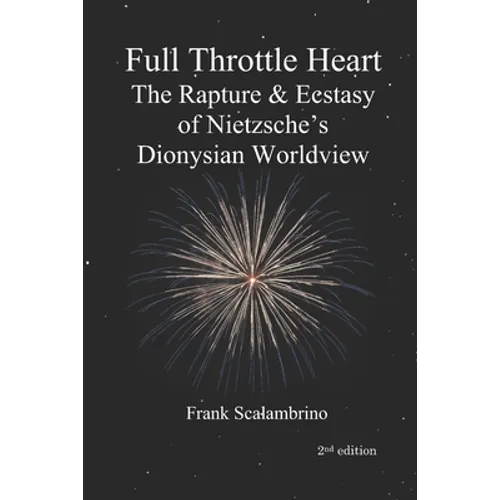
The critical side of Friedrich Nietzsche's (1844-1900) philosophy was aimed at modernity: he believed that with modernization came the loss of the "highest" and "noblest" types of humans and the societal conditions to produce them. The positive side of Nietzsche's philosophy was aimed at retrieving the Worldview of ancient Greek culture. As incoherent as the critical side of Nietzsche's philosophy may seem, the positive side of his philosophy is consistent; thus, the positive side can render both sides more coherent. In tracing the history of humanity's degeneration into modernity, Nietzsche came to recognize Aristophanes' complaints against Euripides and Socrates as an original revelation of Western culture's steep decline. In other words, the philosophy of Euripides leads to a worldview in which human dignity is devalued, and the philosophy of Socrates leads to a worldview constituted by nihilism. Given our decadent modern position in the history of humanity, the original Western Worldview of the ancient Greeks may be difficult to envision. Yet, Nietzsche discovered that how the ancient Greeks understood tragedy reveals both how they understood existence and how they lived with the dignity of an authentic nobility. Ancient Greek culture honored the sense in which existence is governed by divine forces - forces which exceed the powers of mortals. Similarly, existential mysteries, such as fate, death, and love, exceed our ability to fully grasp them, and, as evidenced by their capacity to overwhelm us, they somehow involve divinity. Thus, according to Nietzsche, the ancient Greeks could exist in authentic communion with such divine forces because the Greeks had a noble relation to their own mortality. This can be envisioned from their point of view regarding tragedy, and Nietzsche called this ancient Greek perspective on existence "the Dionysian Worldview." According to the ancient Greeks: Time is a circle, Dionysus is a god, and a "god" is "that which lights up a world." Thus, on the one hand, the general response which the Dionysian Worldview calls for regarding the Eternal Recurrence of existence, including of course the tragic, may be philosophically characterized as Amor Fati. On the other hand, Full Throttle Heart characterizes the particular experience of Amor Fati in response to tragedy: a response that confirms the Dionysian Worldview by experiencing tragedy as the rapture and ecstasy of divine affectivity. This book is divided into three parts. The first part, "How to Read Nietzsche" shows Nietzsche's philosophy as sufficiently consistent such that readers should be able to turn to any passage throughout Nietzsche's writings and have their bearings. The second part presents the first edition's frolicking, romping, and exhorting dithyrambs in light of the insight that the Dionysian Worldview is the unifying principle of Nietzsche's philosophy. This includes a discussion of the Mysteries of Dionysus as they relate to Plato's dialogs and the Eleusinian Mysteries. Lastly, the third part of this book provides Scalambrino's translation of Nietzsche's so-called "Madness Letters" from January, 1889.