


Product Description
by Erik S. Reinert (Editor), Philipp Robinson Rössner (Editor), Leonhard Fronsperger (Author)
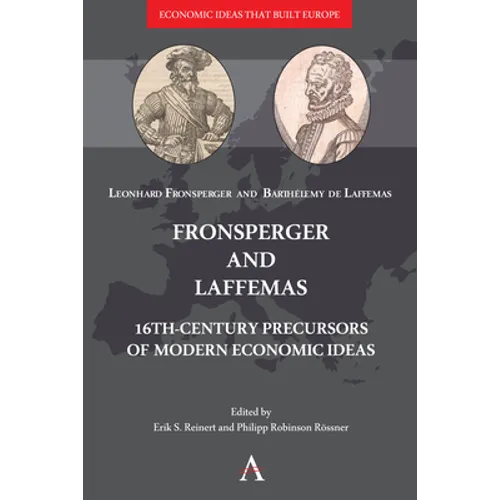
This volume introduces two unique and hitherto largely unknown contributions published in the 1500s to the making of modern economic knowledge, making them available internationally for the first time in full English translation.
- Written in 1597, Barthélemy de Laffemas' General regulation for the establishment of manufactures (written originally in French: Reiglement général pour dresser les manufactures) represents one of the earliest voices in the history of political economy - together with Italian economists Giovanni Botero (1589) and Antonio Serra (1613) - arguing that manufacturing and industry are the true sources of the wealth of nations and that states
should pursue an active industrial policy. Located at the crossroads between medieval Scholasticism and early mercantilism, it presents a political program that would lead to French economic development, providing the foundations for the French industrialization program during the 1660s-1680s. Laffemas presents a simplified version of an infant industry argument and European standard model of economic development known from thoughts of Enlightenment thinkers such as Colbert, Sir James Steuart, Friedrich List's National System of Political Economy (1841), nineteenth and twentieth-century theories for catching up with England and later the US, and the 'industrial policy' or recently 'mission-driven' policies (Mariana Mazzucato).
- Leonhard Fronsperger's On the praise of self-interest (German original: Von dem Lob de Eigen Nutzen, 1564) is the first documented instance of the 'Mandeville paradox', one of the key axioms of neoliberalism. Commonly associated with much later writings, including Bernard de Mandeville's Fable of the Bees (1705/14), and Adam Smith's Wealth of Nations (1776), German military surgeon and polymath Fronsperger argued in 1564 that self-interest is an important driver in economic development. In his text, however, Fronsperger is much more pragmatic and less ideological than Mandeville or post-Mandevillean modern neoliberals. Vested in Renaissance Humanism and directly associated with the master of his time - Erasmus of Rotterdam - Fronsperger develops Renaissance theory about homo faber (creative, driven humans) as the center of the world to perfection, deriving from it the logical conclusion that possessive individualism and self-interest are important forces moving the human economy forward. Without letting go of the state, this work argues for self-interest facilitating virtuous cycles of enrichment and positive economic development.
Author Biography
Erik S. Reinert is Professor of Technology Governance and Development Strategies, Tallinn University of Technology. He is also Honorary Professor, Institute for Innovation and Public Purpose, University College London.
Philipp Robinson Rössner is Professor (chair) of Early Modern History, The University of Manchester.



