


Product Description
by Joseph Straubhaar (Author), Melissa Santillana (Author), Vanessa de Macedo Higgins Joyce (Author)
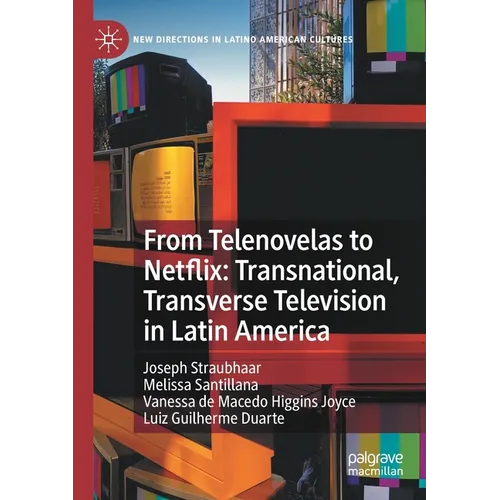
This book is about television in Latin America. Its national and regional industries create most television programming there within genres developed over time in the region. However, part of the programming has always come from the U.S., Europe and elsewhere. With cable, satellite and now streaming TV, that inflow of foreign programming has increased substantially. While many in the audience still prefer national or regional programs for their cultural proximity, an increasing number among the upper-middle and middle classes, particularly the young, are turning to the new foreign services, like Netflix, Amazon and Disney for class distinction, cosmopolitanism or other motives. Among the television industries, global, regional and national actors are creating a variety of programs and channels (broadcast, pay-TV and streaming) to segment and appeal to different parts of the audience.
Back Jacket
This book is about television in Latin America. Its national and regional industries create most television programming there within genres developed over time in the region. However, part of the programming has always come from the U.S., Europe and elsewhere. With cable, satellite and now streaming TV, that inflow of foreign programming has increased substantially. While many in the audience still prefer national or regional programs for their cultural proximity, an increasing number among the upper-middle and middle classes, particularly the young, are turning to the new foreign services, like Netflix, Amazon and Disney for class distinction, cosmopolitanism or other motives. Among the television industries global regional and national actors are creating a variety of programs and channels (broadcast, pay-TV and streaming) to segment and appeal to different parts of the audience.
Joseph Straubhaar is the Amon G. Carter, Sr. Centennial Professor of Communication in the Moody College of Communication at the University of Texas at Austin. He was previously Director of the Brazil Center in the Lozano Long Institute of Latin American Studies. He was co-author of Latin American Television Industries. His research focuses on global media, television in Latin America, and the digital divide in Texas and Latin America.
Melissa Santillana is a doctoral candidate in the Department of Radio-Television-Film at the University of Texas at Austin. Her research focuses on international media flows, border studies, activist movements, feminist activism, digital media, and digital inequality.
Vanessa de Macedo Higgins Joyce is an Associate Professor in the School of Journalism and Mass Communication at Texas State University and a Research Fellow at the Knight Center for Journalism in the Americas. Her research lies in the intersection of transnational media, digital journalism, consensus building, and Latin America.
Luiz Guilherme Duarte is an international media research executive with awards for the developments of pioneer television measurement services. He is also adjunct professor at University of Central Florida.
Author Biography
Joseph Straubhaar is the Amon G. Carter, Sr. Centennial Professor of Communication in the Moody College of Communication at the University of Texas at Austin. He was previously Director of the Brazil Center in the Lozano Long Institute of Latin American Studies. He was co-author of Latin American Television Industries. His research focuses on global media, television in Latin America, and the digital divide in Texas and Latin America.
Vanessa de Macedo Higgins Joyce is an Associate Professor in the School of Journalism and Mass Communication at Texas State University and a Research Fellow at the Knight Center for Journalism in the Americas. Her research lies in the intersection of transnational media, digital journalism, consensus building, and Latin America.
Melissa Santillana is a doctoral candidate in the Department of Radio-Television-Film at the University of Texas at Austin. Her research focuses on international media flows, border studies, activist movements, feminist activism, digital media, and digital inequality.
Luiz Guilherme Duarte is an international media research executive with awards for the developments of pioneer television measurement services. He is also adjunct professor at University of Central Florida.



