


Product Description
by Robert Trumbull (Author)
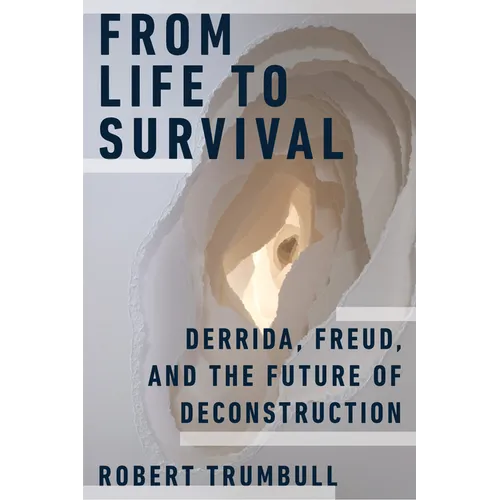
Contemporary continental thought is marked by a move away from the "linguistic turn" in twentieth-century European philosophy, as new materialisms and ontologies seek to leave behind the thinking of language central to poststructuralism as it has been traditionally understood. At the same time, biopolitical philosophy has brought critical attention to the question of life, examining new formations of life and death. Within this broader turn, Derridean deconstruction, with its apparent focus on language, writing, and textuality, is generally set aside.
This book, by contrast, shows the continued relevance of deconstruction for contemporary thought's engagement with resolutely material issues and with matters of life and the living. Trumbull elaborates Derrida's thinking of life across his work, specifically his recasting of life as "life death," and in turn, survival or living on. Derrida's activation of Freud, Trumbull shows, is central to this problematic and its consequences, especially deconstruction's ethical and political possibilities. The book traces how Derrida's early treatment of Freud and his mobilization of Freud's death drive allow us to grasp the deconstructive thought of life as constitutively exposed to death, the logic subsequently rearticulated in the notion of survival. Derrida's recasting of life as survival, Trumbull demonstrates, allows deconstruction to destabilize inherited understandings of life, death, and the political, including the dominant configurations of sovereignty and the death penalty.Back Jacket
"Trumbull's book distinguishes itself by the ambitious scope of its argument, which undertakes a new understanding of the status of life throughout Derrida's work. Through original argument, he reconstructs a Derridean concept of life (life death) as made possible by a trace that runs throughout Derrida's work, from his early texts on Husserl, through responses to psychoanalysis, Nietzsche and Heidegger, to the more obviously "political" work, such as Derrida's writing on the death penalty. Trumbull's exploration of the normative aspects of Derrida's work is informed by an innovative account of the status of norms within vitalism and Foucauldian biopower, producing a new understanding of deconstructive politics."--Penelope Deutscher, Northwestern University
Contemporary continental thought is marked by a move away from the "linguistic turn" in twentieth-century European philosophy, as new materialisms and ontologies seek to leave behind the thinking of language central to poststructuralism as it has been traditionally understood. At the same time, biopolitical philosophy has brought critical attention to the question of life, examining new formations of life and death. Within this broader turn, Derridean deconstruction, with its apparent focus on language, writing, and textuality, is generally set aside. This book, by contrast, shows the continued relevance of deconstruction for contemporary thought's engagement with resolutely material issues and with matters of life and the living. Trumbull elaborates Derrida's thinking of life across his work, specifically his recasting of life as "life death," and in turn, survival or living on. Derrida's activation of Freud, Trumbull shows, is central to this problematic and its consequences, especially deconstruction's ethical and political possibilities. The book traces how Derrida's early treatment of Freud and his mobilization of Freud's death drive allow us to grasp the deconstructive thought of life as constitutively exposed to death, the logic subsequently rearticulated in the notion of survival. Derrida's recasting of life as survival, Trumbull demonstrates, allows deconstruction to destabilize inherited understandings of life, death, and the political, including the dominant configurations of sovereignty and the death penalty. Robert Trumbull teaches Philosophy at Seattle University.Author Biography
Robert Trumbull teaches Philosophy at Seattle University.



