Skip to content
Welcome To Our Store.
100,000+ Products for Home, Medical, Office & Classroom Needs
Search
Skip to product information
1 of 2

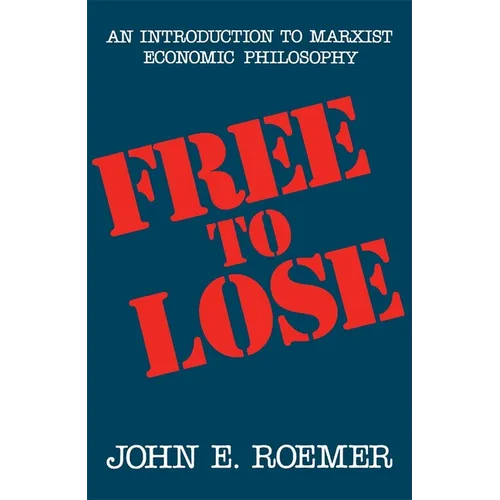
Free to Lose: An Introduction to Marxist Economic Philosophy - Paperback

$64.80 USD
$64.80 USD
Sale Sold out
Shipping calculated at checkout.
In stock (100 units), ready to be shipped

Available Offers

Fast delivery available on most orders

Multiple secure payment options accepted

Secure checkout with
  • American Express
  • Apple Pay
  • Diners Club
  • Discover
  • Google Pay
  • Mastercard
  • PayPal
  • Shop Pay
  • Visa

Flight Range: Up to 1,000 meters (3,280 feet)

Maximum Speed: 45 kilometers per hour (28 miles per hour)

For all orders exceeding a value of 100USD shipping is offered for free.

Returns will be accepted for up to 10 days of Customer’s receipt or tracking number on unworn items. You, as a Customer, are obliged to inform us via email before you return the item.

Otherwise, standard shipping charges apply. Check out our delivery Terms & Conditions for more details.

View Product Details
Shopping cart
Product Product subtotal Quantity Price Product subtotal
Free to Lose: An Introduction to Marxist Economic Philosophy - Paperback
$64.80/ea
$0.00
$64.80/ea $0.00

Product Description

by John E. Roemer (Author)

Attacking the usefulness of such central Marxian concepts as the labor theory of value and surplus value, John Roemer reconstructs Marxian economic philosophy from the concepts of exploitation and class, showing that exploitation can be derived from a system of property relations. He then looks at the causes of the unequal distribution of wealth, including robbery and plunder, willingness to take risks, differential rates of time preference, luck, and entrepreneurship. He further examines the evolution of property systems--slave, feudal, capitalist, socialist--from the perspective of the theory of historical materialism, and ends by analyzing the properties of a social system in which ownership of productive assets in the external world is public, while ownership of internal productive assets--skills and talents--is private.


Number of Pages: 216
Dimensions: 0.49 x 9 x 6 IN
Publication Date: January 01, 1988
you might like
