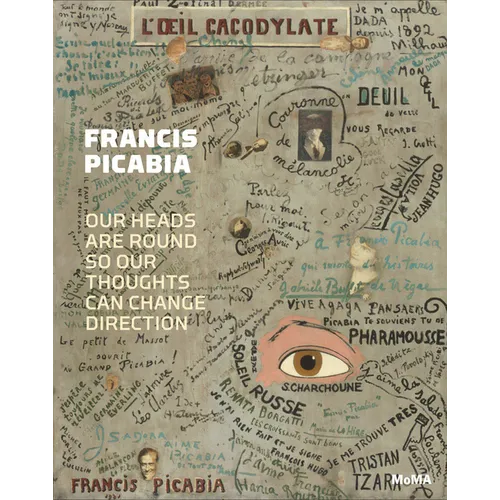
Product Description
by Francis Picabia (Artist), Anne Umland (Editor), Cathérine Hug (Editor)
By rejecting consistency, Picabia powerfully asserted the artist's freedom to change
Irreverent and audacious, restless and brilliant, Francis Picabia achieved fame as a leader of the Dada group only to break publicly with the movement in 1921. Moving between Paris, the French Riviera, Switzerland, and New York, he led a dashing life, painting, writing, yachting, gambling, racing fast cars, and organizing lavish parties. Like no other artist before him, Picabia created a body of work that defies consistency and categorization, from Impressionist landscapes to abstraction, from Dada to stylized nudes, and from performance and film to poetry and publishing. A primary constant in his career was his vigorous unpredictability.
Illustrated with nearly 500 reproductions, this sweeping survey of Picabia's eclectic career embraces the challenge of his work, asking how we can make sense of its wildly shifting mediums and styles. In her opening essay, curator Anne Umland writes that with Picabia, familiar oppositions between high art and kitsch, progression and regression, modernism and its opposite, and success and failure are undone.
In 15 superb essays, additional authors--including distinguished professors George Baker, Briony Fer, and David Joselit and renowned Picabia scholars Carole Boulbès and Arnauld Pierre--delve into the radically various mediums, styles, and contexts of Picabia's work, discussing his Dada period, his abstractions, his mechanical paintings, his appropriations of source imagery, his multifaceted relationship with print (both in his paintings and as a publisher and contributor to vanguard journals), his forays into screenwriting and theater, and his complex politics. Marcel Duchamp, of course, but also Nietzsche and Gertrude Stein make repeat appearances along the way.
Turning to Picabia's contemporary legacy, Cathérine Hug maps the history of his critical reception and interviews contemporary curators and artists, including Peter Fischli, Albert Oehlen, and David Salle. A lively 30-page chronology illustrated with archival photographs and ephemera gives readers a year-by-year account of the artist's colorful life and of his interactions with fellow artists and critics, friends, and lovers.
Together these essays suggest that the unruly genius of Picabia offers us a powerfully relevant and provocative alternative to the familiar narrative of modernism.
Francis Picabia: Our Heads Are Round So Our Thoughts Can Change Direction accompanies the major 2016 exhibition on the artist, jointly organized by The Museum of Modern Art, New York, and the Kunsthaus Zürich.
Francis Picabia was born in 1879 in Paris, the only child of a Cuban-born Spanish father and a French mother. His first success came as a painter in an Impressionist manner. He went on to become one of the principle figures of the Dada movement in New York and Paris. In 1925 Picabia moved to the south of France, where he lived and worked through World War II. Following the war, Picabia returned to Paris, where he died in 1953.
Author Biography
Anne Umland is the Blanchette Hooker Rockefeller Curator of Painting and Sculpture at the Museum of Modern Art, New York.
Cathérine Hug is Curator, 20th Century Art at the Kunsthaus Zürich, Switzerland.