


Product Description
by Gage Averill (Author)
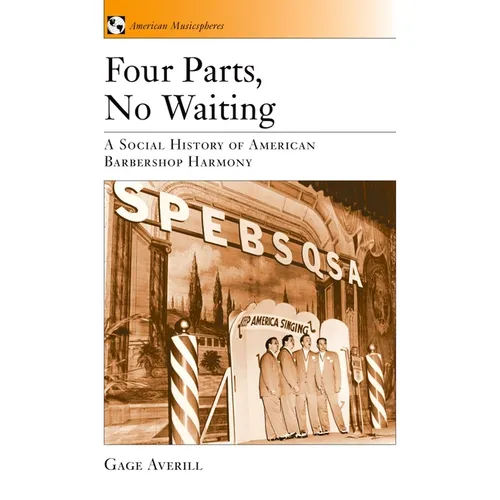
Four Parts, No Waiting investigates the role that vernacular, barbershop-style close harmony has played in American musical history, in American life, and in the American imagination. Starting with a discussion of the first craze for Austrian four-part close harmony in the 1830s, Averill traces the popularity of this musical form in minstrel shows, black recreational singing, vaudeville, early recordings, and in the barbershop revival of the 1930s. In his exploration of barbershop, Averill uncovers a rich musical tradition--a hybrid of black and white cultural forms, practiced by amateurs, and part of a mythologized vision of small-town American life. Barbershop harmony played a central -- and overlooked -- role in the panorama of American music. Averill demonstrates that the barbershop revival was part of a depression-era neo-Victorian revival, spurred on by insecurities of economic and social change. Contemporary barbershop singing turns this nostalgic vision into lived experience. Arguing that the "old songs" function as repositories of idealized social memory, Averill reveals ideologies of gender, race, and class. This engagingly-written, often funny book critiques the nostalgic myths (especially racial myths) that have surrounded the barbershop revival, but also celebrates the civic-minded, participatory spirit of barbershop harmony. The contents of the CD have been replaced by a companion website with helpful links, resources, and audio examples.
Author Biography
Gage Averill is Professor of Ethnomusicology at the University of Toronto and Vice-Principal Academic and Dean of the University of Toronto Mississauga. He serves as President of the Society of Ethnomusicology (2009-11).



